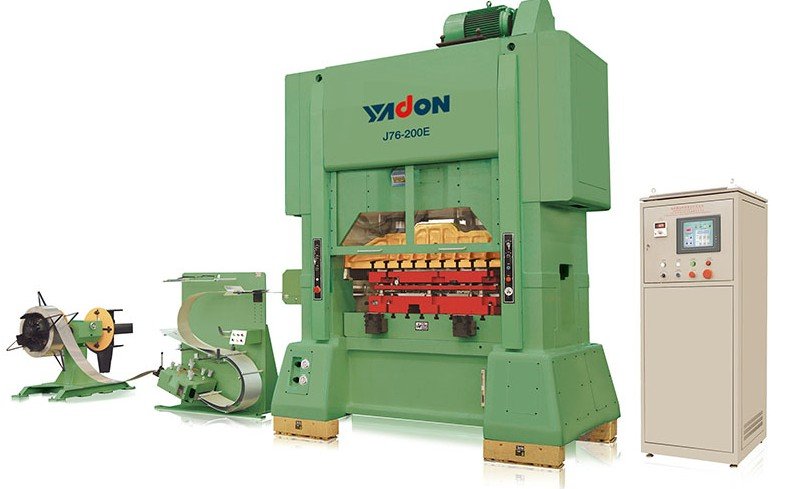
The heart of our plant at Machohalli, Bengaluru is a complete high-speed stamping line built around a 220-ton Yadon J76-220 mechanical press. Here is how the line works, step by step, and what each machine contributes to quality.
1. Double-reel decoiler
Production starts with a coil of electrical steel loaded onto the double-reel decoiler. With two reels, the next coil can be prepared while the current one is running, which cuts changeover time. It takes coils up to 1200 mm outer diameter, 300 mm wide and 1500 kg per reel.
2. S-type straightener
Coiled steel has a natural curve, called coil set. The S-type straightener flattens the strip before it reaches the die. Flat strip means flat laminations and a consistent stack. It handles strip 0.2–1.0 mm thick at up to 60 m/min.
3. High-speed servo feeder
The SNCF-300 servo feeder, driven by YASKAWA servo motors and motion control, pushes the strip into the die by exactly the right distance (the "pitch") at every stroke. Accurate feeding is what keeps every slot in the right place across thousands of strokes.
4. The 220-ton press
| Specification | Value |
|---|---|
| Rated tonnage | 220 tons |
| Strokes per minute | 120 – 400 spm |
| Slide stroke | 30 mm |
| Max. die setting height | 420 mm |
| Table size | 1900 × 700 mm |
| Main motor | 37 kW |
The large table and die height let us run wide progressive dies for bigger stator profiles, while the high stroke rate delivers the volumes that EV and appliance-motor programmes need. Electrical components from Schneider, a Pro-face HMI and a Hengstler encoder keep the line stable and easy to monitor.
Backed by in-house tool maintenance and secondary operations
Our dies are maintained in-house by the same team that runs them, keeping cutting edges sharp – which is key to low burr and zero-defect output. A 40-ton hydraulic secondary press handles follow-on operations, and rotor shafts are machined in-house on an Ace Designers Super Jobber 500 LM CNC turning centre, so more of the motor core comes from one plant.