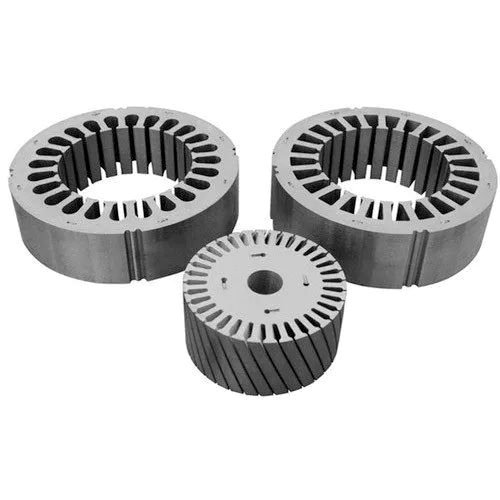
Open up almost any electric motor – in an EV, a ceiling fan, a water pump or an industrial drive – and you will find two cores made from hundreds of thin steel sheets stacked together: the stator (the stationary part) and the rotor (the rotating part). These sheets are called laminations, and making them accurately is the job of a precision stamping plant like ours.
Why are motor cores made of thin sheets?
A motor core carries a changing magnetic field. If the core were a solid block of steel, that changing field would set up circulating currents inside the metal – known as eddy currents – which waste energy as heat. Splitting the core into thin, insulated sheets breaks up those current paths. The thinner the sheet, the lower the loss, which is why high-efficiency and high-speed motors, such as those used in EVs, use very thin electrical steel.
What is electrical steel?
Laminations are usually stamped from CRNGO (cold-rolled non-grain-oriented) electrical steel. It is a silicon steel designed to magnetise easily in every direction and it comes with a thin insulating coating on the surface. The motor designer chooses the grade and thickness; the stamper's job is to cut it cleanly without damaging those properties.
What makes a good lamination?
- Tight dimensional accuracy – slot shapes, bore and outer diameter must match the drawing so the air gap between rotor and stator stays uniform.
- Low burr height – a burr is the small raised edge left by cutting. High burrs can bridge the insulation between sheets, increase losses and make the stack uneven.
- Flatness – warped sheets give a loose, inconsistent stack.
- Consistent stack height and squareness – so the finished core fits the motor housing and winding process every time.
How laminations are stamped
Laminations are produced on high-speed presses using progressive dies. A coil of electrical steel is unwound, straightened and fed into the die in precise steps. At each press stroke, a different station cuts part of the profile – pilot holes, rotor slots, stator slots, and finally the outer shape – so a finished lamination drops out with every stroke. Well-maintained, sharp tooling and a stable feed are what keep burr and dimensions under control over long production runs.
Where SNV fits in
At SNV Stamping Solutions we manufacture stator and rotor stampings for electric vehicles, industrial motors, agriculture and robotics. Our high-speed press line handles strip thicknesses from 0.2 mm to 1.0 mm, our in-house tool maintenance keeps dies sharp for low burr, we machine rotor shafts in-house, and we have welding equipment for rotor and stator cores – so a customer can move smoothly from loose laminations to assembled stacks.