India is set to become one of the world's largest electric motor markets within the next decade. This article explains what motor lamination material is, how to choose the right one, and why India's policy moves and industry investments are creating a once-in-a-generation opportunity for motor manufacturers and their supply chain.
India's Rising Role in Global Motor Manufacturing
India's electric motor market was valued at USD 15.9 billion in 2025 and is projected to reach USD 28.8 billion by 2035, growing at 6.11% CAGR (Market Research Future). The EV motor segment alone is expected to hit USD 4.16 billion by 2030 at a 17.45% CAGR (Newstrail). These are not projections sitting in a report. They are backed by real factory investments happening right now across Karnataka, Tamil Nadu, Gujarat and Maharashtra.
Three forces are driving this growth. First, India's government has committed over INR 10,900 crore through the PM E-DRIVE scheme (replacing FAME) to accelerate EV adoption — targeting 2.47 million electric two-wheelers, 316,000 electric three-wheelers and 14,028 electric buses. Second, the Production-Linked Incentive (PLI) scheme for auto and auto components, worth INR 25,938 crore, directly incentivises domestic manufacturing of EV motors and drivetrains. Third, India's target of 30% EV penetration by 2030 means every motor, every lamination, every stamping will need to be sourced — and increasingly, sourced domestically.
An IEEFA-JMK Research report (June 2026) found that several non-battery EV component categories, including traction motors and power electronics, could reach 90-100% localisation by 2030. The motor lamination — the stator and rotor core made from electrical steel — sits at the heart of every one of these motors. Whoever masters the lamination supply chain in India over the next five years will own a critical position in a USD 28 billion market.
How to Choose the Right Lamination Material for Your Motor
The lamination material you choose directly decides your motor's efficiency, heat generation, noise level, and cost. A wrong material choice at the design stage leads to wasted energy in every motor produced for the life of the product. Let us break this down systematically.
What Is Electrical Steel and Why Does It Matter?
Electrical steel (also called silicon steel or lamination steel) is a special alloy of iron with 0.5% to 6.5% silicon content. The silicon does two things: it increases the electrical resistivity of the steel, which reduces eddy current losses, and it improves magnetic permeability, which allows the motor core to carry more magnetic flux with less energy.
Every motor core is made by stacking thin sheets (laminations) of this steel. The sheets are insulated from each other by a thin oxide or phosphate coating. This stacking and insulation is what controls eddy current losses — thinner sheets mean lower losses at high frequencies.
There are two main types:
- CRNO (Cold Rolled Non-Oriented) electrical steel: Magnetic properties are uniform in all directions. Used in rotating machines — motors, generators, compressors. This is what motor lamination manufacturers work with.
- CRGO (Cold Rolled Grain-Oriented) electrical steel: Magnetic properties are best in the rolling direction. Used in transformers where flux flows in one direction. Not used for motor laminations.
Silicon Steel Grades — Understanding the Naming System
Electrical steel grades follow two common naming systems:
IEC/BIS system (used in India): The grade name tells you the thickness and maximum core loss. For example, 50C600 means 0.50 mm thick, with maximum core loss of 6.00 W/kg at 1.5 Tesla and 50 Hz. Similarly, 35C330 means 0.35 mm thick with maximum core loss of 3.30 W/kg.
ASTM/AISI system (used in the US): Grades like M19, M27, M36, M45, M47 follow a different convention. Lower numbers generally indicate lower core loss and better magnetic performance. M19 is one of the most commonly used grades worldwide for motor laminations.
| Grade (IEC) | Grade (ASTM) | Thickness | Max Core Loss (W/kg at 1.5T, 50Hz) | Silicon Content | Best Used For |
|---|---|---|---|---|---|
| 35C250 | M15 | 0.35 mm | 2.50 | 3.0-3.5% | High-efficiency BLDC, PMSM, servo motors |
| 35C330 | M19 | 0.35 mm | 3.30 | 2.8-3.2% | Premium industrial motors, EV traction motors |
| 50C470 | M27 | 0.50 mm | 4.70 | 2.5-3.0% | BLDC motors, universal motors |
| 50C600 | M36 | 0.50 mm | 6.00 | 2.0-2.8% | Industrial motors, fan motors, pump motors |
| 50C800 | M45 | 0.50 mm | 8.00 | 1.5-2.0% | General purpose motors, low-cost applications |
| 50C1300 | M47 | 0.50 mm | 13.00 | 0.5-1.5% | Small household motors, low-cost laminations |
How to Choose — The Five Factors
1. Operating frequency: This is the single most important factor. At frequencies below 400 Hz (most industrial motors, ceiling fans, pump motors), standard 0.50 mm CRNO steel works well. Between 400 Hz and 1000 Hz (EV traction motors, high-speed BLDC motors), you need thinner steel — 0.35 mm or even 0.25 mm — because eddy current losses increase with the square of frequency. Above 1000 Hz (aerospace, ultra-high-speed spindle motors), 6.5% high-silicon steel or amorphous alloys become necessary.
2. Core loss budget: Every watt lost in the core is wasted energy that becomes heat. For an EV motor running thousands of hours over the vehicle's life, even a 0.5 W/kg difference in core loss translates to measurable range loss. A Voestalpine study found that switching from 0.35 mm to 0.25 mm steel reduces eddy current losses significantly, but stamping output drops from about 32 stacks/hour to 19 stacks/hour for a 250 mm stator — a 1.7x increase in press time. The efficiency gain must justify the higher production cost.
3. Flux density requirement: Higher silicon content improves loss performance but reduces saturation flux density. A motor design that needs high flux density (compact motors, high torque density) may perform better with a lower-silicon grade like 50C600 than a premium 35C250 that saturates earlier.
4. Motor type:
- BLDC and PMSM motors (EV, drones, appliances): Use M19/35C330 or M27/50C470 — these motors operate at variable frequency through an inverter, so low core loss across a wide frequency range is critical.
- Induction motors (industrial, pumps, compressors): M36/50C600 or M45/50C800 works well for standard IE2/IE3 efficiency. For IE4/IE5 premium efficiency, step up to M19/35C330.
- Universal motors (power tools, mixer grinders, vacuum cleaners): M19 or M27 — these motors run at very high speed (10,000-30,000 RPM) on commutated DC, so lower core loss matters.
- Ceiling and table fan motors: M36/50C600 is the standard. For BLDC fans (like Atomberg), M27 or better.
5. Cost: Premium grades cost 20-40% more than standard grades. For a product that sells millions of units (like a ceiling fan motor), even INR 2-3 per lamination set adds up. The right approach is to calculate the total cost of ownership — material cost plus energy loss over the motor's lifetime — and choose the grade that gives the lowest total cost.
The Thickness Decision — When Thin Is Worth It
Thinner silicon steel laminations reduce eddy current losses but cost more to produce. Here is the practical framework:
- 0.50 mm: Standard for line-frequency (50 Hz) motors — fans, pumps, industrial drives. Good balance of cost and performance.
- 0.35 mm: The sweet spot for most EV and BLDC applications running at 200-800 Hz. Used widely in two-wheeler and three-wheeler EV motors in India.
- 0.25 mm: Justified for high-speed EV traction motors (car/bus) running above 800 Hz, where efficiency directly translates to battery range. Stamping requires higher precision presses and tighter tolerances.
- 0.20 mm and below: Used in aerospace, high-speed spindle motors, and premium automotive applications. Requires specialised stamping equipment and handling.
The trend globally is toward thinner steel. Cardiff University research projects that 0.10 mm grades will be available for ultra-high-speed motors by 2030. For Indian motor manufacturers, the practical question today is whether your stamping partner can handle 0.35 mm or 0.25 mm steel with the required burr control (below 0.02 mm) and stacking factor (above 97%).
India's Steel Policy and the JSW-JFE Game Changer in Karnataka
The Import Dependency Problem
India has been almost entirely dependent on imports for electrical steel, particularly CRNO grades used in motor laminations. Until recently, no Indian steel maker produced CRNO or CRGO at scale. Motor manufacturers, transformer makers and electrical stamping suppliers all sourced their electrical steel from Japan (JFE, Nippon Steel), South Korea (POSCO), Europe (Voestalpine, ThyssenKrupp) or China.
China became the dominant supplier, especially for commodity CRNO grades, because of aggressive pricing. This led to a serious problem: Chinese electrical steel was being dumped into India at prices below fair market value, hurting any chance of domestic production becoming viable.
India's Anti-Dumping Response
In 2025, India imposed a five-year anti-dumping duty of USD 223.80 to USD 414.90 per tonne on CRNO electrical steel imports from China. This was a decisive policy move. The duty protects domestic manufacturers and makes the economics of producing electrical steel in India viable for the first time.
A separate anti-dumping investigation for CRGO steel was opened in June 2026, signalling that the government intends to protect the entire electrical steel value chain.
JSW Steel's CRNO Production at Vijayanagar
JSW Steel, at its Vijayanagar steel complex in Bellary district, Karnataka, set up India's first CRNO electrical steel production facility with a capacity of 2,00,000 tonnes per annum. The technology partner is JFE Steel Corporation of Japan. This facility was India's first step toward self-reliance in motor-grade electrical steel.
The Rs 5,500 Crore JSW-JFE Joint Venture for CRGO
In February 2024, JSW Steel and JFE Steel Corporation took this partnership further by establishing JSW JFE Electrical Steel Private Limited — a 50:50 joint venture to manufacture grain-oriented electrical steel (GOES/CRGO) in India.
Key details of this JV:
- Investment: Rs 5,500 crore (approximately USD 670 million)
- Location: Bellary district, Karnataka (adjacent to JSW's existing Vijayanagar complex)
- Product: Grain-oriented electrical steel in conventional and high-permeability grades
- Production start: Full operation planned from fiscal year 2027
- Significance: This will be the first company to manufacture CRGO products end-to-end in India
JFE Steel also holds a 15% stake in JSW Steel, making this a deeply committed strategic partnership rather than a licensing deal.
What This Means for Motor Manufacturers
For the motor lamination industry, the combination of domestic CRNO production at Vijayanagar and the upcoming CRGO facility changes the supply chain fundamentally:
- Shorter lead times: Instead of 8-12 week import cycles from Japan or Korea, motor manufacturers can source electrical steel from within Karnataka with 1-2 week delivery.
- Price stability: Domestic production shields manufacturers from currency fluctuations and international shipping cost volatility.
- Custom grades: With a domestic producer, Indian motor manufacturers can eventually request custom electrical steel specifications tailored to Indian motor designs.
- Reduced working capital: Shorter supply chains mean lower inventory requirements, freeing up capital for growth.
Major Motor Company Investments and JVs in India
The scale of investment flowing into electric motor manufacturing in India is unprecedented. Here are the most significant moves:
Nidec Corporation (Japan) — USD 7.8 Billion India Commitment
Nidec, the world's largest motor manufacturer, has made India a cornerstone of its global strategy. Their investments include:
- Hubli, Karnataka: A 50-acre Orchard Hub Campus with USD 55 million investment — Nidec's eighth and largest Indian facility. Six plants will manufacture EV motors, controllers, EV chargers, generators for data centres, wind turbine generators, and battery energy storage systems. Over 2,000 jobs (direct and indirect) will be created.
- Neemrana, Rajasthan: Third plant for automotive motors, expanding existing operations.
- Overall India plan: Nidec's total committed investment in India is USD 7.8 billion, covering EV motors, industrial drives, and high-efficiency motor systems. The company follows an "India for India" and "India for Exports" strategy.
ZF Group (Germany) — Rs 18,700 Crore Investment
ZF Group has committed over Rs 18,700 crore to India, with a strong focus on EV powertrains. Their new Tamil Nadu plant (Rs 1,800 crore investment) focuses on EV drivetrain components including electric motors and inverters, with plans for both domestic supply and exports.
Minda Corporation — Turntide Technologies JV
Minda Corporation and Turntide Technologies have formed a joint venture to develop and manufacture advanced EV powertrain solutions for the Indian market, including switched reluctance motors, motor controllers, and integrated drive units. The JV targets Rs 75-100 crore in initial revenue.
BorgWarner (USA) — India as a Strategic EV Hub
BorgWarner has expanded its India footprint with facilities in Manesar and Talegaon, manufacturing EV motor components, power electronics and thermal management systems. The company has stated that India will play a significant role in its global EV strategy going forward.
Tata Motors — In-House EV Motor Manufacturing
Tata Motors, India's largest EV maker, has started EV production at its Sanand facility in Gujarat (the former Ford plant acquired for its EV business) and is ramping up in-house manufacturing of EV motors and drivetrains across its Pune and Sanand facilities.
Other Notable Investments
- MAHLE (Germany): Hiked stake to 90% in its India JV, betting on e-mobility components including electric motors and thermal management.
- Sona Comstar: India's largest listed auto-component company for EV drivetrains, manufacturing differential assemblies and motor components at its Gurgaon and Chennai plants.
- Bosch India: Expanding its EV motor and power electronics manufacturing across multiple Indian facilities.
- Mitsubishi Electric: Inaugurated a Rs 2,100 crore AC and compressor factory at Ponneri, Chennai in February 2026, manufacturing 3 lakh AC units and 6.5 lakh compressors per year — all needing motor laminations.
What This Investment Wave Means for the Lamination Supply Chain
Every single one of these motor manufacturing facilities needs stator and rotor laminations. A single EV motor plant producing 500,000 motors per year consumes thousands of tonnes of electrical steel stamped into laminations. The demand for precision motor stamping in India is about to multiply several times over, and the current domestic stamping capacity is nowhere close to meeting it.
The Problem: Why Indian Motor Manufacturers Still Struggle with Lamination Quality
Despite the massive investments flowing in, Indian motor manufacturers face a painful reality on the shop floor. Motor lamination quality remains inconsistent, material sourcing is unreliable, and most OEMs still depend on a handful of established (often foreign) stamping suppliers.
The pain points that motor OEMs experience every day:
- Inconsistent burr levels: Many Indian stamping shops produce laminations with burr heights of 0.05-0.10 mm, when modern BLDC and PMSM motors require below 0.02 mm. Excessive burr causes inter-lamination short circuits, increased core losses, and premature motor failure.
- Poor stacking factor: A stacking factor below 95% means the motor core has air gaps between laminations, reducing the effective magnetic material and the motor's efficiency. World-class stamping achieves 97-98%.
- Material grade mismatch: OEMs specify M19 or 35C330, but receive laminations stamped from lower grades because suppliers substitute material to save cost. The motor runs hotter, loses efficiency, and the OEM cannot trace the root cause.
- Long lead times for imported steel: CRNO from Japan or Korea takes 8-12 weeks to arrive. Chinese steel is cheaper but quality varies batch to batch. Indian motor manufacturers carry 2-3 months of inventory just to keep production running.
- Lack of thin-gauge stamping capability: Very few Indian stamping shops can reliably stamp 0.25 mm or 0.30 mm electrical steel. Most are equipped for 0.50 mm. As EV motor designs move to thinner laminations for higher frequency operation, this capability gap becomes a bottleneck.
- No traceability: Most Indian stamping suppliers cannot provide material test certificates, incoming inspection data, or process parameter records for each batch. For OEMs pursuing IATF 16949 or supplying to automotive customers, this is a disqualifier.
Root Cause Analysis — Using Toyota Business Practice (TBP) to Understand the Gap
In Toyota's problem-solving approach, we break every big problem into its smallest parts and address each root cause individually. The motor lamination quality gap in India has four distinct root causes.
Root Cause 1: India Had No Domestic Electrical Steel Production Until Recently
For decades, India imported 100% of its CRNO electrical steel. No Indian steel company invested in the specialised cold-rolling, annealing and coating lines needed to produce motor-grade silicon steel. JSW's Vijayanagar CRNO line (2,00,000 TPA) is the first, and the JSW-JFE CRGO JV (Rs 5,500 crore) will be the second. Until these reach full capacity and cover the full range of grades (from 50C1300 to 35C250), Indian motor manufacturers will continue to depend partly on imports.
Root Cause 2: Most Indian Stamping Shops Use General-Purpose Equipment
Motor lamination stamping is not general sheet metal work. It requires high-speed precision presses (200+ SPM), servo feeders with tight pitch accuracy, progressive dies with in-die auto-stacking, and burr control below 0.02 mm. Most Indian press shops operate mechanical presses designed for structural components, not thin electrical steel.
The specific equipment needs:
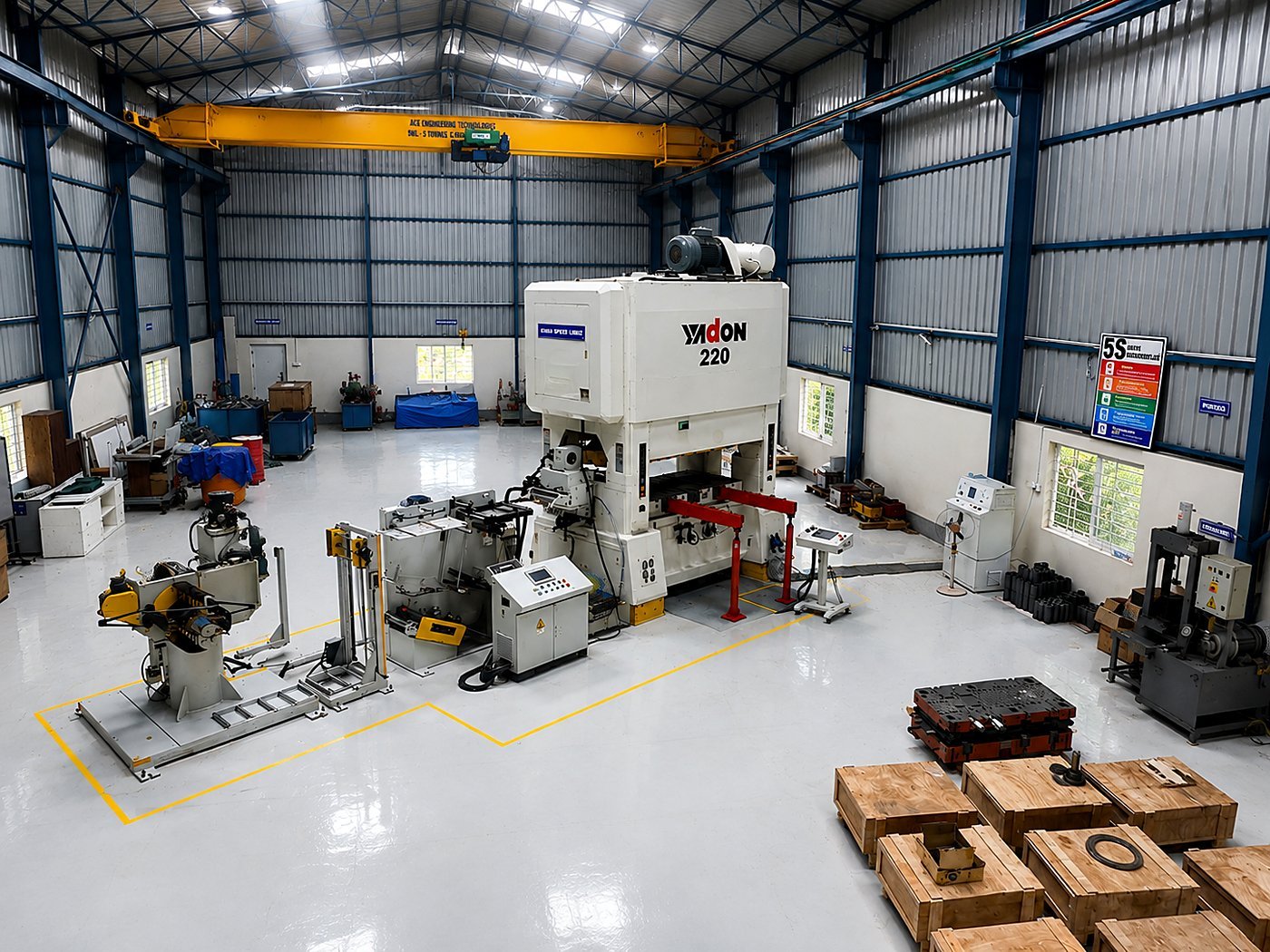
- Press: High-speed presses with parallelism within 50 microns across the bolster. A double-plunger design (like the Yadon J76 220T) keeps the tool perfectly parallel for consistent lamination quality.
- Feeder: Servo feeders (like Yaskawa) capable of handling 0.20 mm to 1.00 mm thickness with consistent feed pitch.
- Tooling: Progressive dies with separate cams for rotor and stator, enabling different stack heights in the same tool. In-die auto-stacking and auto-skewing for assembled stator cores.
- Quality control: Burr measurement, stacking factor verification, and dimensional accuracy within 10-15 microns.
Root Cause 3: Limited Knowledge of Motor-Specific Material Science
Many Indian stamping companies treat electrical steel like any other sheet metal. They do not understand how silicon content affects stampability, how annealing temperature affects core loss, or why grain orientation matters. This knowledge gap leads to wrong material selection, poor die maintenance (dull punches increase burr), and incorrect press parameters.
Root Cause 4: Fragmented Supply Chain with No Integration
In mature markets (Japan, Germany, South Korea), the lamination supply chain is tightly integrated. The steel maker, the stamper, and the motor OEM work together from the design stage. In India, these three players often do not communicate. The OEM designs the motor, sends a drawing to a stamper, the stamper buys whatever steel is available, and the result is a lamination that meets dimensional specs but fails on magnetic performance.
Solutions — Building India's Motor Lamination Ecosystem (A PDCA Approach)
Using Toyota's Plan-Do-Check-Act cycle, here is how India can close the lamination quality and supply gap.
Plan: Define What "World-Class" Looks Like
Before solving, define the standard. A world-class motor lamination meets these parameters:
| Parameter | Target | Current Indian Average |
|---|---|---|
| Burr height | Below 0.02 mm | 0.05-0.10 mm |
| Stacking factor | 97-98% | 92-95% |
| Dimensional accuracy | Within 10-15 microns | 30-50 microns |
| Material traceability | 100% lot-wise | Rarely available |
| Core loss consistency | Within +/-5% of spec | +/-15-20% variation |
| Thin gauge capability | 0.25 mm | Most shops limited to 0.50 mm |
Do: Invest in the Right Infrastructure
For steel producers: JSW's CRNO production at Vijayanagar and the JSW-JFE CRGO JV at Bellary are the right steps. The next phase should include developing thinner gauges (0.25 mm and 0.30 mm CRNO) for the EV motor market, and qualifying these grades with Indian motor OEMs.
For stamping companies: The investment priority is clear — high-speed precision press lines with servo feeders, progressive die capability with in-die auto-stacking, and quality measurement systems. A company stamping motor laminations needs to think like a motor company, not like a general press shop.
For motor OEMs: Work with your lamination supplier from the motor design stage. Share the operating frequency, efficiency target, and flux density requirements. Let the stamper recommend the material grade and lamination thickness, rather than specifying it in isolation.
Check: Measure and Verify at Every Stage
- Incoming material inspection: Verify the electrical steel grade matches the material test certificate. Measure thickness, hardness, and coating quality.
- In-process checks: Monitor burr height every 500 strokes. Track die wear and schedule regrinding before burr exceeds limits.
- Final inspection: Measure stacking factor, dimensional accuracy, and shaft concentricity (for rotor assemblies with pressed shafts).
- Implement IATF 16949 quality management systems if you serve automotive customers.
Act: Build Long-Term Partnerships
The companies that will lead India's motor lamination industry in 2030 and beyond are the ones building partnerships today:
- With steel makers: Secure committed supply agreements with JSW or approved import sources. Build relationships that give you priority allocation during supply shortages.
- With motor OEMs: Move beyond transactional quoting. Offer prototype development, design-for-manufacturing feedback, and quality data that the OEM can use for their motor certification.
- With technology partners: Invest in die design capability, either in-house or through partnerships with die makers who understand motor lamination geometry.
The Opportunity Window
India's motor market is crossing USD 16 billion. Global motor companies are building factories here. Domestic electrical steel production is starting. Government policy (anti-dumping duties, PLI, PM E-DRIVE) is aligned. All of this is happening in a compressed 5-7 year window.
The motor manufacturers setting up factories today will qualify their lamination suppliers within the next 2-3 years. Once qualified, these suppliers will be embedded in the supply chain for a decade or more. The window to become a qualified supplier is now — not five years from now when the factories are already running at full capacity with established vendors.
Sources
- India Electric Motors Market Report — Market Research Future
- India EV Motor Market to Reach USD 4.16 Bn by 2030 — Newstrail
- PM E-DRIVE Scheme Replaces FAME Policy — India Briefing
- India's EV Localisation Gaining Ground — IEEFA-JMK Research
- JFE Steel Press Release: JSW JFE Electrical Steel JV
- JSW-JFE JV Invests Rs 5,500 Cr in Bellary — Swarajya
- JSW Steel CRNO Facility at Vijayanagar — MoneyWorks4Me
- India Anti-Dumping Duty on CRNO from China — SteelOrbis
- Nidec Orchard Hub Campus, Hubli — Nidec Press Release
- ZF Group Rs 18,700 Crore India Investment — IANS
- Minda-Turntide EV Powertrain JV — EV Reporter
- Voestalpine: Electrical Steel Thickness in Motors
- Cardiff University: Thinner Electrical Steels
- Motor Core Design — Silicon Steel Selection Guide 2025 — CH Laser
- Silicon Steel Grade Selection for Motor Laminations — LamMotor
- India Can Achieve 90-100% EV Component Localisation by 2030 — Business Today