For many years, a large share of the stator and rotor laminations and other motor parts used in India came from China. It was simple: Chinese stampers had scale, tooling and low prices. That picture is now changing. Indian fan, appliance, pump and EV motor makers are moving their motor supply chains home, and the next 5 to 7 years will decide who builds that capacity.
Why the shift is happening now
- Energy-efficiency rules. BEE's revised star rating tables for ceiling fans apply from 1 January 2026 to 31 December 2028. To reach higher star ratings, more fan makers are moving to BLDC motors – and every new BLDC motor design needs new, accurate laminations.
- Rising cost of imported steel. India has put anti-dumping duty on CRNO electrical steel from China. Imported cores and laminations no longer carry the price advantage they once did.
- Supply security. Shipping delays, freight spikes and border issues in recent years showed how risky it is to depend on one overseas source for a part that stops the whole motor line when it runs short.
- Make in India and PLI. Government schemes for electronics, white goods, auto and EVs reward local value addition. A locally stamped motor core adds to that value.
What a local lamination supplier changes for a motor maker
- Shorter lead time. Parts come by road in days, not by sea in weeks. Less stock is tied up in transit and in the warehouse.
- Faster design changes. When a stack height, slot shape or material grade changes, a local partner can make samples and trial quantities quickly – important when BLDC designs are still evolving.
- Easier quality control. Your engineers can visit the press shop, see the tool, check burr, flatness and stack height, and solve problems face to face.
- Payment in rupees, no import paperwork. No currency risk, customs clearance or minimum container loads.
The next 5 to 7 years
BLDC fans and appliances, EV two- and three-wheelers, solar pumps and industrial automation are all growing in India. Each of them runs on electric motors, and each motor needs laminations. The companies that localise their motor parts now will have stable, qualified Indian suppliers in place when volumes climb. Those who wait may find capacity already booked.
Where SNV fits in
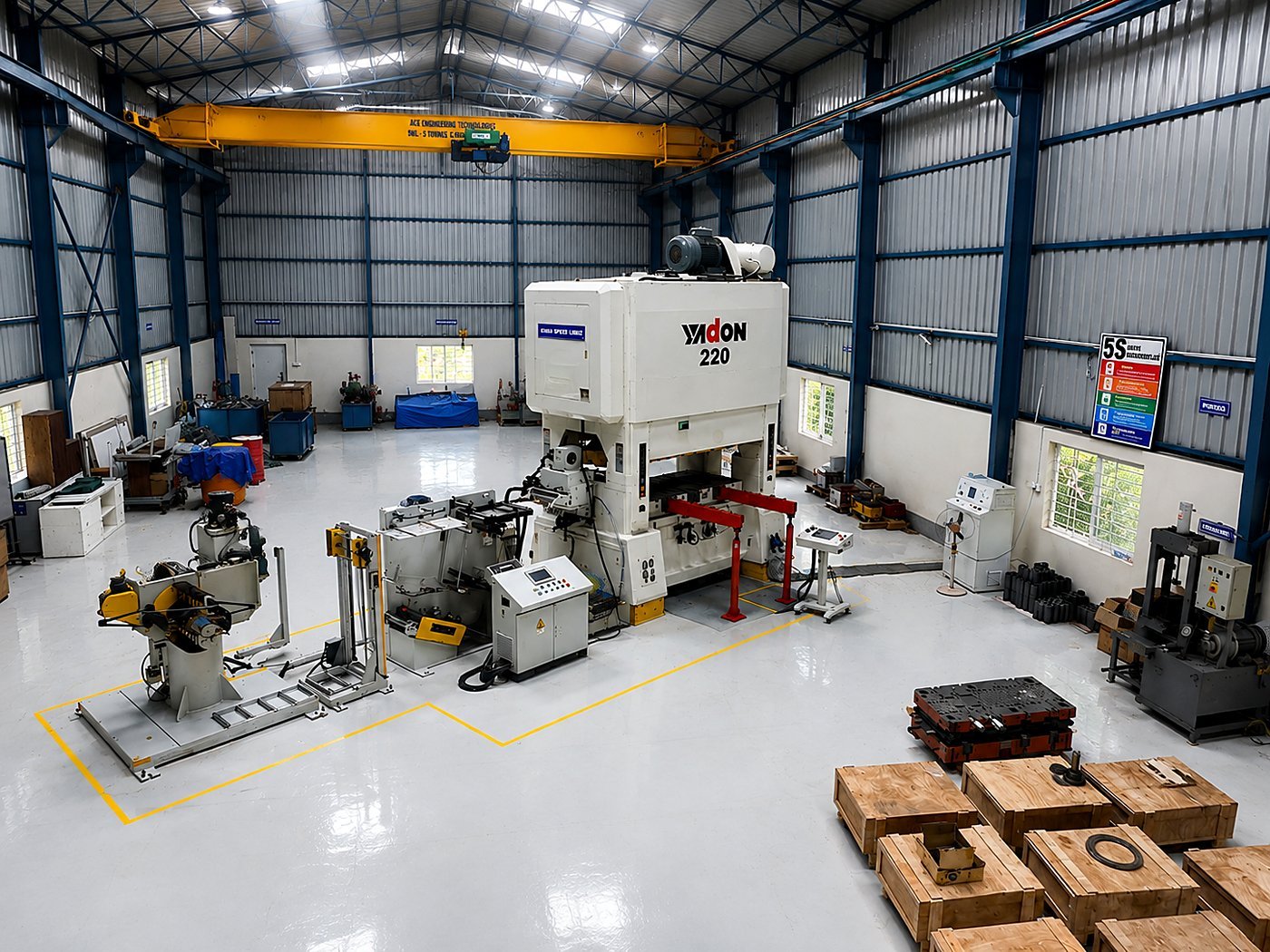
SNV Stamping Solutions was founded in Bengaluru in 2025 by engineers from Toyota and Bosch to be the partner Indian OEMs localise with. Our 220-ton Yadon double-plunger high-speed press line with Yaskawa servo feeder stamps stator and rotor laminations from 0.2 to 1.0 mm strip, up to 400 mm wide, at 120 to 400 strokes per minute. Our progressive dies auto-stack and auto-skew in the die, with separate cams for rotor and stator so different stack heights are easy. We also weld cores, machine rotor shafts on CNC and maintain our tools in-house – all under ISO 9001:2015.
We work in CRNO silicon steel (50C1300 to 50C330 or equivalent) and CRCA, for home-appliance, automobile, EV, industrial, robotics, drone and irrigation motors.
Planning to localise a motor or lamination? Send us your drawing and we will come back with a quote and a sample plan.