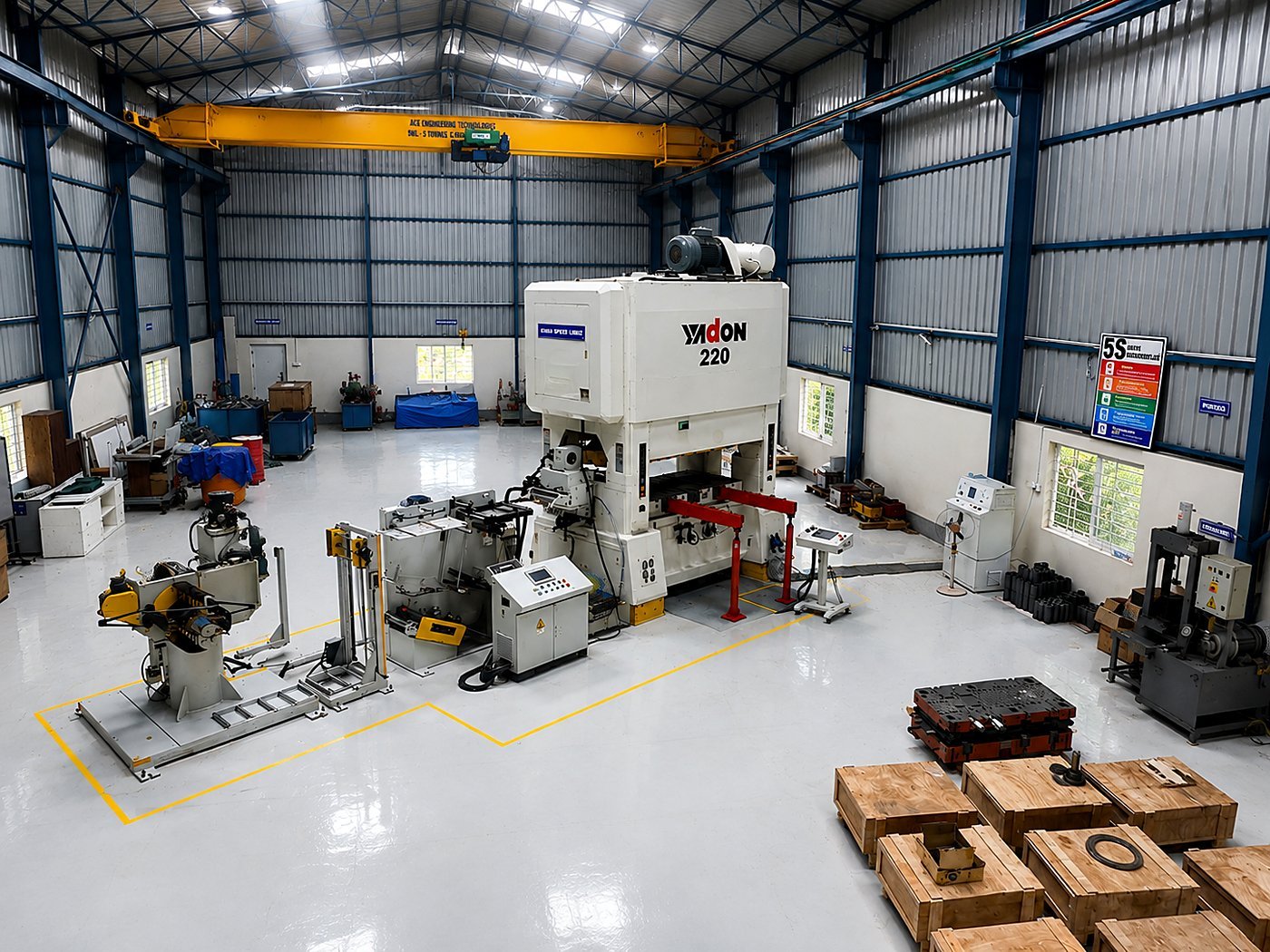
SNV Stamping Solutions Pvt Ltd is a motor lamination manufacturer in India, based in Bengaluru, Karnataka. We stamp stator laminations, rotor laminations and complete stator-and-rotor sets to your drawing on a 220-ton high-speed press line, and supply them as loose laminations, auto-stacked cores or welded cores. This page explains what a motor lamination is, how lamination quality decides motor performance, where Indian motor makers usually lose money on laminations, and how we have set up our plant to avoid those losses.
What a motor lamination is, and why it matters
A motor lamination is one thin sheet of electrical steel, punched to the shape of the stator or rotor. Hundreds of these sheets are stacked together to form the motor core. The core carries the magnetic flux that makes the motor turn. Because the sheets are thin and insulated from each other, the core wastes much less energy as heat than a solid block of steel would.
Two things decide how good a core is. The first is the material: the grade and thickness of the silicon steel lamination. The second is the stamping: how accurately the shape is punched, how small the burr is, and how consistent every sheet is across the whole stack. A motor maker can buy the best steel in the world and still get a poor motor if the stamping is loose.
Lamination stamping we do
- Stator laminations: inner-stator and outer-stator designs for BLDC, induction and universal motors, with slot shapes punched to your drawing.
- Rotor laminations: squirrel-cage, armature and interior permanent magnet (IPM) rotor laminations, auto-skewed in the die where the design needs it.
- Stator and rotor together: both laminations punched from the same strip in one progressive die. This saves material and keeps the air gap consistent, because the stator inner diameter and rotor outer diameter come from the same strip position.
- Motor cores: interlocked (auto-stacked) cores from the die, and TIG or laser welded cores with a controlled stacking factor.
- Prototype and pilot batches: small runs for new motor designs before you commit to production tooling.
Press line, tooling and materials
Our main line is a 220-ton Yadon high-speed press with Yaskawa servo feeding, running at 120 to 400 strokes per minute on 0.2 to 1.0 mm strip up to 400 mm wide. A decoiler and straightener feed the strip, and progressive tools stack and skew the laminations in the die. Separate cams for rotor and stator mean stack heights can be changed without stopping for long.
We stamp CRNO electrical (silicon) steel from 50C1300 to 50C330 or equivalent, including M19, M27, M36, M43 and M47 grades, and CRCA (CR2 to IS 513) for appliance motors. We can work from your approved steel source or arrange material from Indian mills and importers.
| Parameter | What we hold | Why it matters to the motor |
|---|---|---|
| Sheet thickness | 0.2 mm to 1.0 mm | Thinner sheets reduce eddy-current loss at high speed |
| Strip width | Up to 400 mm | Covers most two-wheeler EV, fan, pump and appliance stators |
| Press speed | 120 to 400 strokes per minute | Volume pricing without losing accuracy |
| Burr height | Controlled against sheet thickness, checked every lot | Low burr keeps the stacking factor high and insulation intact |
| Stacking factor (welded cores) | Above 97% | More steel in the core means more torque per kg |
| Inspection | First-off approval, in-process checks, lot report | Every stack behaves the same as the sample you approved |
Motors we make laminations for
- EV motors: hub motors and mid-drive motors for electric two- and three-wheelers. See our EV motor lamination page.
- BLDC motors: ceiling fans, pumps, appliances and industrial drives. See BLDC stator rotor stamping.
- Fan motors: ceiling fans and pedestal, table and wall fans. See fan motor laminations.
- Mixer grinder motors: universal motor stator and armature laminations. See mixer grinder motor laminations.
- Other motors: automobile starter and door motors, industrial and robotics motors, drone and defence motors, irrigation and pump motors.
The problem: where Indian motor makers lose money on laminations
Most motor makers we meet have faced at least one of these. Rejections at the winding stage because slots are not consistent across the stack. Noise and heating in the finished motor that cannot be traced to the winding or the magnets. A lamination supplier who delivers the first lot well and then drifts. Imported laminations that tie up cash for eight to twelve weeks and make every design change slow. And no lot report, so when a problem appears there is nothing to go back to.
Each of these costs money in a different place: scrap on the winding line, warranty returns from the field, working capital locked in transit, or engineering time spent on a design change that should have taken a week.
Root causes, broken down
We use a simple habit from the automotive press shops we come from: break the big problem into small parts and find the root cause of each. For laminations, the problems above come down to four root causes.
- Die wear not tracked. As a progressive die wears, burr height goes up and slot dimensions drift. If nobody measures burr lot by lot, the first sign is a rejection on the customer's line.
- Material not matched to the motor. A thick, high-loss grade used in a high-speed BLDC motor will heat up no matter how well it is stamped. Many suppliers stamp whatever is cheapest that month.
- Stacking done by hand. Hand-stacked cores have a low and variable stacking factor. Two cores from the same lot can perform differently.
- No first-off discipline. Without a signed first-off sample and a lot report, there is no reference to compare against when something goes wrong.
How we have set up the plant to remove each root cause
We planned the plant around these four causes, and we check the results on every lot. This is the Plan-Do-Check-Act cycle in practice, not a slogan.
- Die wear: burr height is measured against sheet thickness on every lot and recorded. Dies are resharpened on a schedule set by the measurements, not by breakdown.
- Material selection: we help you choose the grade and thickness for the motor's speed, efficiency target and cost. If your drawing already specifies the grade, we source and stamp exactly that, with mill certificates attached.
- Stacking: cores are interlocked in the die or welded on a fixture, so the stacking factor is set by the tool, not by the operator.
- First-off discipline: every new part starts with a first-off sample you approve. Every lot ships with a report covering dimensions, burr and stack height, so there is always a reference.
Why Indian motor makers choose an Indian lamination supplier
Imported laminations tie up cash in long lead times and make design changes slow. A supplier in India lets you visit the press line, approve first-off samples quickly, and change a slot shape or stack height in days rather than months. Freight and customs costs disappear from the lamination price. And with the PM E-DRIVE and PLI schemes rewarding domestic content, an Indian lamination source helps your localisation numbers as well as your lead time.
Bengaluru is a good place for this. The city and its surroundings have a large base of motor, pump, fan, appliance and EV makers, and road connections to Tamil Nadu, Maharashtra and Gujarat clusters are good. We dispatch across India.
How to send an enquiry
Send us the lamination drawing or a sample part, the steel grade and thickness if already fixed, the stack height, and the monthly quantity you expect. If the design is still open, tell us the motor type, speed and efficiency target and we will suggest a grade and thickness. You will get a clear quote with tooling and piece price shown separately. Write to sales@snvstampings.com or use the contact page.
Frequently asked questions
Are you a motor lamination manufacturer in India?
Yes. SNV Stamping Solutions Pvt Ltd stamps stator and rotor laminations at its own ISO 9001:2015 certified plant in Bengaluru, Karnataka, and dispatches to customers across India.
Can you stamp the stator and rotor lamination together?
Yes. Our progressive dies can punch the stator and rotor from the same strip in one pass, then stack each part in the die. This keeps the air gap consistent and saves material.
What thickness and width can you stamp?
0.2 mm to 1.0 mm sheet, with strip widths up to 400 mm, on a 220-ton high-speed press.
Which materials do you use for motor laminations?
CRNO electrical (silicon) steel from 50C1300 to 50C330 or equivalent, including M19 to M47 grades, and CRCA (CR2 to IS 513) for appliance motors.
Do you supply loose laminations or finished cores?
Both. We supply loose laminations, interlocked (auto-stacked) cores from the die, and TIG or laser welded cores with a stacking factor above 97%.
What is the minimum order quantity?
There is no fixed minimum. We run prototype and pilot batches for new designs and production volumes for established parts. Tooling cost is quoted separately so you can see the piece price clearly.
How long does a new part take?
For a new progressive die, first-off samples are typically ready in six to ten weeks depending on complexity. For parts that fit an existing tool, samples can be ready in days.