SNV Stamping Solutions Pvt Ltd is a stator and rotor manufacturer in India. From our ISO 9001:2015 certified plant in Bengaluru, Karnataka, we make motor stator and motor rotor stampings, laminated stator cores and rotor cores for electric motors of every size, from ceiling fans and mixer grinders to EV hub motors and industrial pumps. We supply loose stator and rotor laminations, interlocked (auto-stacked) cores and welded cores, and dispatch across India.
What a stator and rotor are, in simple words
Every electric motor has two main magnetic parts. The stator is the part that stays still. It carries the winding (or magnets in some designs) and produces a rotating magnetic field. The rotor is the part that turns. It sits inside the stator (or outside it, in outer-rotor motors) with a small air gap between them. Both parts are built from stacks of thin electrical steel sheets called laminations, punched to shape and stacked into a core.
A stator and rotor manufacturer therefore does three things: punches the laminations accurately, stacks them into a core with a high stacking factor, and keeps the stator and rotor dimensions matched so that the air gap is even all the way round. If any of these slips, the motor runs hot, makes noise and wastes power.
Stator and rotor products we manufacture
- Stator laminations and stator cores: inner-stator and outer-stator designs for BLDC, induction, PMSM and universal motors. Supplied loose, interlocked or welded.
- Rotor laminations and rotor cores: squirrel-cage rotors for induction motors, permanent-magnet (SPM and IPM) rotors for BLDC and EV motors, and armature laminations for universal and DC motors. Auto-skewed in the die where the design calls for it.
- Matched stator and rotor sets: both parts punched from the same strip in one progressive die, so the stator bore and rotor outer diameter are always concentric.
- Rotor shafts: CNC-turned shafts with press-fit or keyed assembly to the rotor core, made in-house.
- Prototype stators and rotors: short runs for new motor designs before production tooling.
Motors we make stators and rotors for
- Ceiling fan, table fan, pedestal fan and wall fan motors (induction and BLDC) — see fan motor stator and rotor laminations
- Mixer grinder, wet grinder and kitchen appliance universal motors — see mixer grinder stator and rotor
- BLDC motors for appliances, pumps and drives — see BLDC stator and rotor
- EV hub motors and mid-drive motors for two and three wheelers — see EV motor stator and rotor
- Pump, submersible, induction, armature and drone motors — see pump, armature and industrial motor laminations and drone motor laminations
How we make them
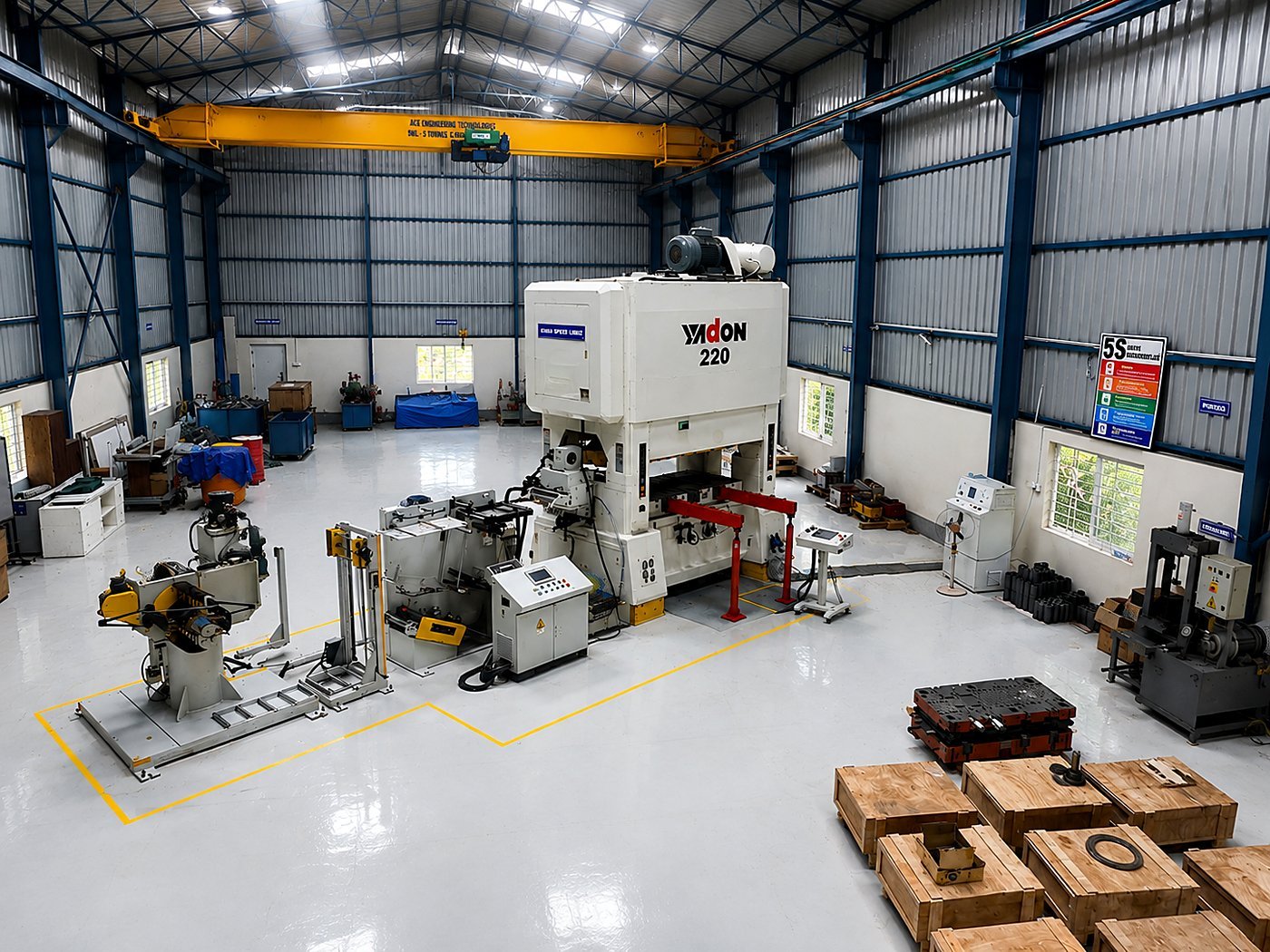
Our main line is a 220-ton Yadon high-speed press with a Yaskawa servo feeder, running 120 to 400 strokes per minute on electrical steel from 0.2 mm to 1.0 mm thick and up to 400 mm wide. Progressive dies stack and skew laminations inside the tool, with separate cams for stator and rotor so stack heights can be changed quickly. A 40-ton hydraulic press handles secondary operations and a CNC turning centre makes rotor shafts. We stamp CRNO silicon steel from 50C1300 to 50C330 (M19 to M47 or equivalent) and CRCA for appliance motors.
| What we control | Specification |
|---|---|
| Sheet thickness | 0.2 mm to 1.0 mm |
| Strip width | Up to 400 mm |
| Burr height on laminations | Within 0.02 mm |
| Stacking factor (welded cores) | 97 to 98% |
| Rotor shaft accuracy | 10 to 15 micron dimensional, concentricity within 30 micron |
| Inspection | First-off approval, in-process checks, lot report with every dispatch |
The problem motor makers face with stator and rotor suppliers
Motor makers tell us the same things. The first lot is good and the later lots drift. The stator and rotor come from two different suppliers and the air gap is uneven. Hand-stacked cores vary in height and in stacking factor. Imported stators and rotors take eight to twelve weeks and every small design change is a long email chain.
Root causes
- Stator and rotor punched on different tools, or different lines, so the two parts are never truly matched.
- No burr tracking, so die wear is noticed only when the winding line starts rejecting.
- Stacking by hand, so the stacking factor depends on the operator that day.
- No first-off and lot report, so there is nothing to compare against when a problem appears.
What we do differently
- Stator and rotor punched from the same strip in one progressive die wherever the design allows.
- Burr measured and recorded on every lot; dies resharpened on the data, not on breakdown.
- Cores interlocked in the die or welded on a fixture, so the stacking factor is set by the tool.
- Every new part starts with a first-off sample you sign, and every lot ships with a report.
Stator and rotor manufacturer in Bangalore, serving all of India
Our plant is at Machohalli on Magadi Road, Bengaluru. Motor makers in Bengaluru, Mysuru, Hosur, Chennai, Coimbatore, Hyderabad and Pune can visit the press line, approve first-off samples in person and get design changes turned around in days. We dispatch to customers anywhere in India.
Frequently asked questions
Are you a stator manufacturer or a rotor manufacturer?
Both. We manufacture stators and rotors as laminations and as finished cores, and we can supply them as matched sets punched from the same strip.
Do you make stator and rotor cores or only laminations?
Both. Loose laminations, interlocked (auto-stacked) cores straight from the die, and TIG or laser welded cores with a stacking factor of 97 to 98%.
Which motor stators and rotors can you make?
Fan motors, mixer grinder motors, BLDC motors, EV hub and mid-drive motors, pump and submersible motors, induction motors, armatures for universal and DC motors, and drone motors. Send the drawing and we will confirm.
What size stator and rotor can you stamp?
Up to 400 mm strip width, in sheet from 0.2 mm to 1.0 mm thick, on a 220-ton high-speed press. This covers most fan, appliance, pump, two-wheeler EV and small industrial motors.
Do you supply stators and rotors outside Bangalore?
Yes. We are in Bengaluru and dispatch to motor makers across India.
Can you make a prototype stator and rotor before I order tooling?
Yes. We run prototype and pilot batches so you can test the motor before committing to a production die.