An agriculture drone is the hardest-working drone in India. It flies with a full tank of liquid, hovers low over crops for most of its flight, and works through May heat, dust and chemical mist. Its motors decide how many acres it sprays before the battery runs out, and how many seasons it lasts.
This guide explains what makes an agri drone motor different, why so many fail early in Indian conditions, and how to fix each root cause. It is part of our complete drone motor guide.
Why agri drones matter so much in India
India has more than 14 crore farm holdings, most of them small. Spraying by hand is slow, uneven and dangerous for the farmer's health. A spray drone covers an acre in a few minutes, uses less water, and keeps the operator away from the chemical. The government is pushing hard:
- The Namo Drone Didi scheme has an outlay of ₹1,261 crore to give 15,000 drones to women's self-help groups from 2023–24 to 2025–26.
- Under the Sub-Mission on Agricultural Mechanisation, up to 50% assistance is available for Kisan Drones for some farmer groups, and 40% for others and for custom hiring centres.
- Between 2023–24 and 2025–26, 2,122 drones were approved for distribution and over 40,000 Kisan Drone demonstrations covered about 41,000 hectares.
Every hexacopter has six motors and every octocopter eight. So 15,000 drones means roughly one lakh heavy-duty motors — plus replacements.
What an agri drone motor looks like
| Tank size | Typical all-up weight | Frame | Thrust needed per motor (max) | Typical motor class |
|---|---|---|---|---|
| 10 litre | ~25 kg | Hexa | ~8 kg | 80–100 mm stator, low KV, 30–36" propeller |
| 16 litre | ~35–40 kg | Hexa / Octo | ~10–12 kg | 90–110 mm stator, 36–40" propeller |
| 20–30 litre | ~45–70 kg | Octo / coaxial | ~12–18 kg | 100–120 mm+ stator, 40–48" propeller |
(Indicative values at about 2 : 1 thrust-to-weight. Each drone maker's numbers differ.)
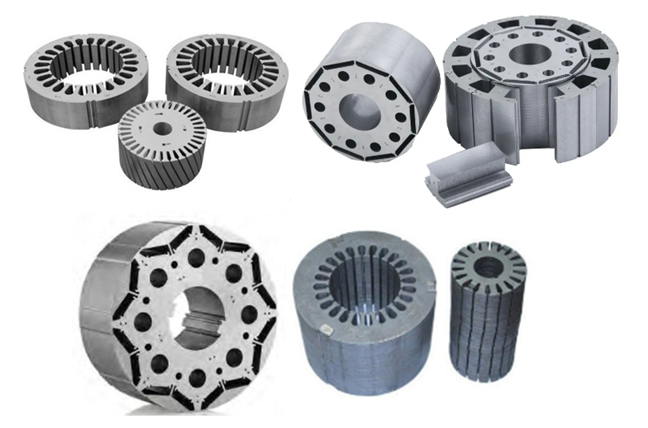
These are outrunner BLDC motors with many poles (36 slots and 42 poles is common) so they can turn a big propeller slowly with high torque and no gearbox. At around 2,800 rpm, a 42-pole motor's steel switches magnetic direction about 980 times a second — twenty times faster than a normal 50 Hz factory motor. That is why the lamination inside matters so much.
Pain points: what agri drone owners and makers tell us
| # | Pain point |
|---|---|
| P1 | Spray time drops sharply in summer; motors are too hot to touch after a flight. |
| P2 | Motors fail after one or two seasons — burnt windings, rusted bearings, weak magnets. |
| P3 | One motor on the drone always runs hotter or draws more current than the others. |
| P4 | Replacement motors are imported, costly, and take weeks during peak season. |
Root causes — breaking each problem down
| Pain | Why? (root causes) |
|---|---|
| P1 Heat in summer | (a) Ambient 40–45 °C leaves little cooling margin. (b) Core loss is high because the stator uses 0.35 mm or thicker steel at ~1 kHz. (c) Burr shorts sheets together and adds eddy loss. (d) The motor is undersized, so it runs near full current at hover. |
| P2 Early failure | (a) Heat cooks winding insulation. (b) Magnet grade not rated for the real temperature, so it loses strength. (c) Chemical spray and dust enter the open bell and bearings. (d) Sharp slot edges nick the wire insulation during winding. |
| P3 One motor hotter | (a) Stack height differs from motor to motor. (b) Burr level differs between batches as the tool wears. (c) Uneven air gap from an out-of-round stack. |
| P4 Import dependence | (a) Few Indian suppliers for large multi-pole drone stators. (b) No local safety stock before the spraying season. |
Solutions — one countermeasure for each root cause (PDCA)
| Root cause | Countermeasure |
|---|---|
| High core loss at ~1 kHz | Move from 0.35 mm to 0.20–0.27 mm high-frequency CRNO. Eddy loss falls with the square of thickness — 0.35 → 0.20 mm cuts it to about one-third. |
| Burr shorting sheets | Specify a burr limit on the drawing (we hold within 0.02 mm) and check every lot. |
| Undersized motor | Choose the stator size for hover current at hot ambient; see our drone motor size chart. |
| Magnet demagnetisation | Use H or SH temperature-grade magnets; check after a hot-room soak. |
| Spray and dust ingress | Sealed bearings, coated stator (epoxy or varnish dip), corrosion-resistant fasteners, IP-rated design. |
| Wire damage in slots | Low burr plus slot liners or epoxy-coated stack edges. |
| Stack height variation | In-die auto stacking with 100% height check. |
| Imports and season delays | Qualify an Indian lamination and motor source before the season; agree safety stock. |
For the steel side in full detail, read drone motor lamination thickness.
How SNV can help
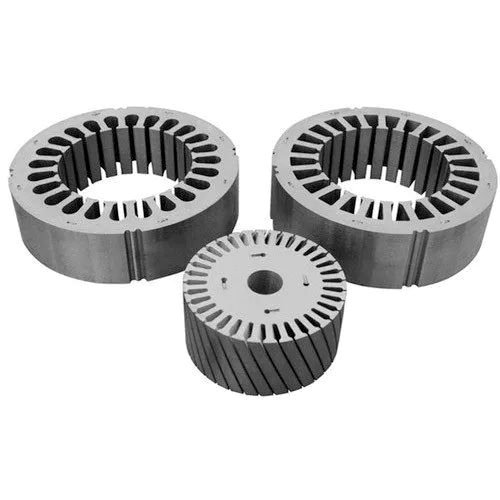
SNV Stamping Solutions Pvt Ltd is an emerging stator and rotor lamination provider in India, based in Bengaluru, with drone and defence motors as one of our focus areas. Our team brings 25+ years of automotive press-shop experience and runs the plant on Toyota Way discipline — TBP and PDCA.
- Brand-new 220-ton high-speed press line with a double-plunger design, parallelism within 50 microns.
- Servo feeder with decoiler and straightener for strip 0.2 mm to 1.0 mm thick, up to 400 mm wide.
- In-die auto stacking, auto skewing, separate cams for rotor and stator stack heights.
- Burr within 0.02 mm; stacking factor 97–98%; CRNO silicon steel for all BLDC and drone motor work.
- In-house CNC turning of rotor shafts — accuracy 10–15 microns, concentricity within 30 microns.
- Prototypes, quick die change, in-house die maintenance. ISO 9001:2015 certified; IATF 16949 implementation started in 2026.
"We don't just press parts — we are a solution provider for motor laminations of your design."
Building agri drone motors? Let us review your stator before the season.
Send us your stator and rotor DXF or drawing, the motor's speed and pole count, and your target volume. We will suggest the steel grade and thickness for your frequency, review the design for punching, and come back with a prototype plan and quotation.
📧 contact@snvstampings.com | sales@snvstampings.com
📞 9980668620 / 9980717774
🌐 www.snvstampings.com
More in this drone motor series
Frequently asked questions
Which motor is best for an agriculture spray drone?
A low-KV, many-pole outrunner BLDC motor sized so the drone hovers at about half throttle with a full tank. For a 10-litre hexacopter this is usually an 80–100 mm class stator driving a 30–36 inch propeller.
Why do agri drone motors overheat in summer?
High ambient temperature leaves little cooling margin, and many motors use thick laminations that waste energy as heat at around 1,000 Hz. Undersizing and burr add to it.
What lamination thickness suits agri drone motors?
Around 0.20–0.27 mm high-frequency CRNO silicon steel for motors working near 1 kHz. 0.35 mm can work for short duty but runs hotter.
How many motors does an agri drone use?
Most spray drones use six (hexacopter) or eight (octocopter or coaxial X8) motors, so a single motor failure does not bring the drone down.