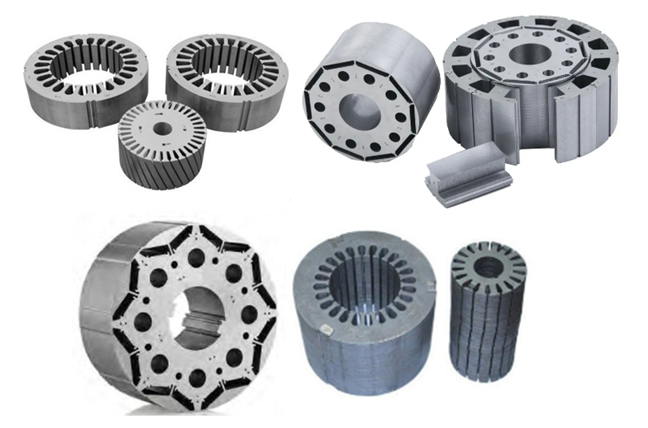
Every drone motor is a brushless permanent magnet motor, but the way the rotor and stator are arranged changes everything: torque, speed, cooling, weight, and how the laminations are made. Here is a practical comparison of the three main types used in drones. It is part of our complete drone motor guide.
The three types in one table
| Outrunner | Inrunner | Frameless | |
|---|---|---|---|
| Where the magnets are | On a rotating bell outside the stator | On a rotor inside the stator | Either — supplied as a loose stator + rotor kit |
| Torque at low speed | High (magnets on a bigger radius) | Lower — often needs a gearbox | Designed to the application |
| Speed range | Low to medium-high | Very high (40,000–100,000+ rpm) | Usually low (gimbals) to medium |
| Cooling | Harder — stator hidden inside | Easier — stator touches the housing | Depends on the host structure |
| Sealing against dust and water | Harder (open bell) | Easy (closed can) | Done by the host product |
| Rotor inertia | Higher | Low — fast response | Varies |
| Typical drone use | Almost all multirotors: FPV, mapping, delivery, agri | Ducted fans (EDF), high-speed fixed-wing, interceptors, geared helicopters | Camera gimbals, actuators, payload mechanisms, custom defence platforms |
| Laminated parts | Stator (thin CRNO); rotor back-iron is usually a steel ring | Stator and rotor core both laminated | Stator and often rotor laminated |
Outrunner — why multirotors use it
Torque is roughly proportional to the square of the air-gap radius. In an outrunner, the magnets sit on the outside, so the same size motor makes more torque. That lets it turn a large propeller directly, with no gearbox — less weight, fewer parts, fewer failures. The trade-off is cooling and sealing: the stator is buried inside the spinning bell, which is why low-loss laminations matter so much for outrunners.
Inrunner — for speed
An inrunner looks like a normal industrial motor. Its rotor is small and light, so it spins very fast and responds quickly. Its stator is outside, touching the housing, so heat escapes easily and the motor is easy to seal. But high speed with several poles means very high electrical frequency — often 2–5 kHz — so the stator and rotor need thin, high-grade steel.
Frameless — built into the product
A frameless motor comes with no shaft, no bearings and no housing. The customer fits the stator into their own structure and the rotor onto their own shaft. Gimbal makers love this for smooth, compact, hollow-centre motors. Defence and aerospace makers use it to save every gram. For India, frameless motors are a big opportunity because the kit is mostly laminations, magnets and copper — all things we can make locally.
Other types worth knowing
- Axial flux (pancake) — disc-shaped, very high torque density; used in heavy-lift cargo drones and eVTOL. Cores are made from soft magnetic composite, tape-wound or segmented laminated steel.
- Brushed coreless — tiny toy drones; cheap but short life.
- Slotless BLDC — no cogging, very smooth, used in precision gimbals.
Pain points when the wrong type is chosen
- Outrunner used in a dusty, wet agri or marine drone without sealing → bearing and winding failures.
- Inrunner used for a large slow propeller without a gearbox → poor efficiency and overheating.
- Off-the-shelf housed motor used in a gimbal or tight defence airframe → extra weight, poor fit, vibration.
Root causes
| Problem | Root cause |
|---|---|
| Failures in harsh environment | Motor type selected for torque only; environment (spray, dust, salt) not part of the specification. |
| Inrunner overheating | Speed and propeller not matched; high-frequency core loss ignored; thick steel used. |
| Weight and fit problems | Buying catalogue motors instead of designing a frameless stator-rotor kit for the product. |
Solutions
Next, size the chosen type with our drone motor size chart.
How SNV can help
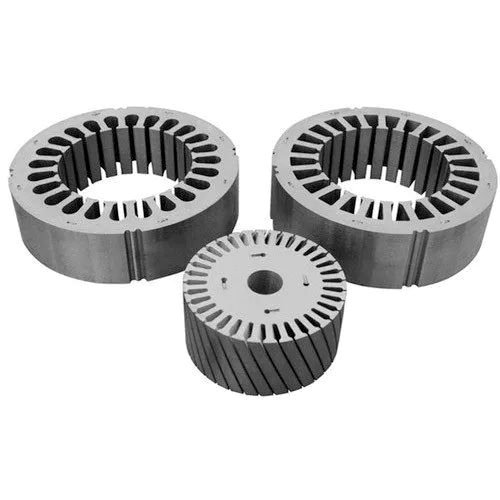
SNV Stamping Solutions Pvt Ltd is an emerging stator and rotor lamination provider in India, based in Bengaluru, with drone and defence motors as one of our focus areas. Our team brings 25+ years of automotive press-shop experience and runs the plant on Toyota Way discipline — TBP and PDCA.
- Brand-new 220-ton high-speed press line with a double-plunger design, parallelism within 50 microns.
- Servo feeder with decoiler and straightener for strip 0.2 mm to 1.0 mm thick, up to 400 mm wide.
- In-die auto stacking, auto skewing, separate cams for rotor and stator stack heights.
- Burr within 0.02 mm; stacking factor 97–98%; CRNO silicon steel for all BLDC and drone motor work.
- In-house CNC turning of rotor shafts — accuracy 10–15 microns, concentricity within 30 microns.
- Prototypes, quick die change, in-house die maintenance. ISO 9001:2015 certified; IATF 16949 implementation started in 2026.
"We don't just press parts — we are a solution provider for motor laminations of your design."
Designing a frameless or custom drone motor? We make the stator and rotor stacks.
Send us your stator and rotor DXF or drawing, the motor's speed and pole count, and your target volume. We will suggest the steel grade and thickness for your frequency, review the design for punching, and come back with a prototype plan and quotation.
📧 contact@snvstampings.com | sales@snvstampings.com
📞 9980668620 / 9980717774
🌐 www.snvstampings.com
More in this drone motor series
Frequently asked questions
Which is better for drones, outrunner or inrunner?
For multirotor drones with direct-drive propellers, outrunners are better because they give more torque at moderate speed. Inrunners are better for ducted fans, very high-speed fixed-wing drones and geared drives.
What is a frameless motor?
A motor supplied only as a stator and a rotor, without shaft, bearings or housing, so it can be built directly into a gimbal, actuator or airframe.
Do outrunner rotors use laminations?
The stator always does. The rotor back-iron of most outrunners is a solid steel ring, though some high-performance designs use laminated rotor rings to cut losses.
Are axial flux motors used in drones?
Yes, mainly in heavy-lift cargo drones and eVTOL aircraft where very high torque in a flat shape is needed.