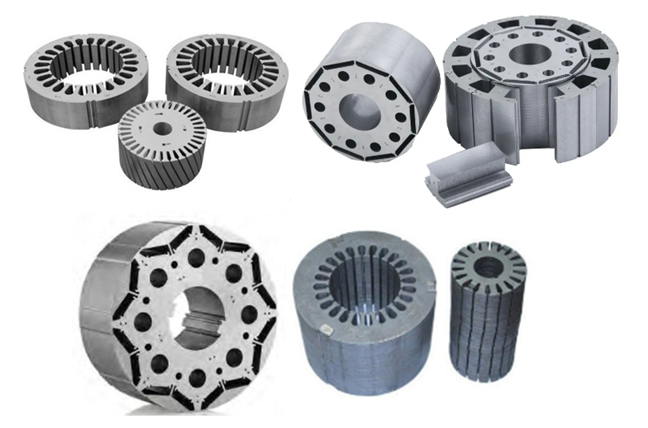
Two drone motors can have the same size, the same magnets and the same winding — and still give different flight times. Very often the difference is inside the stator: the thickness and quality of the silicon steel laminations. This guide explains why, in simple words, for designers and buyers. It is part of our complete drone motor guide.
Why drone motors need thinner steel than normal motors
The steel in a motor's stator is magnetised one way, then the other, every time a magnet pole passes a tooth. The number of times per second is the electrical frequency:
f (Hz) = rpm × poles ÷ 120
| Motor | Frequency |
|---|---|
| Normal 4-pole factory motor | 50 Hz |
| Mapping quad motor, 14 poles at 5,000 rpm | ~580 Hz |
| Agri drone motor, 42 poles at 2,800 rpm | ~980 Hz |
| 5-inch FPV motor, 14 poles at 30,000 rpm | ~3,500 Hz |
Every flip wastes some energy as heat in the steel — the core loss. One part of it, the eddy current loss, rises with the square of frequency and the square of sheet thickness:
Eddy loss ∝ (thickness × frequency × flux density)² ÷ resistivity
At 50 Hz this loss is small. At 1,000–3,500 Hz it becomes the biggest loss in the motor. The only practical fixes are thinner sheet, higher-silicon (higher-resistivity) steel, and good insulation between sheets.
Thickness comparison
| Thickness | Relative eddy loss (0.35 mm = 1.00) | Cost and handling | Where it fits in drones |
|---|---|---|---|
| 0.50 mm | 2.04 | Cheapest, easy to punch | Not suitable for drone motors |
| 0.35 mm | 1.00 | Low cost, widely available | Budget motors, short-duty use, low-pole motors |
| 0.27 mm | 0.60 | Moderate | Mapping and agri motors where cost matters |
| 0.20 mm | 0.33 | Higher; careful punching needed | Quality agri, delivery and FPV motors |
| 0.15 mm | 0.18 | High; often bonded stacks | Premium, defence, high-speed inrunners |
| 0.10 mm | 0.08 | Highest; special handling | Aerospace, kHz-range motors |
(Relative eddy loss from the thickness-squared rule at equal frequency, flux and resistivity. Real losses also depend on grade, coating and processing — always check the steel mill's data at your frequency, for example W10/400 or W10/1000.)
How to read high-frequency steel grades
Steel mills usually name thin grades with the thickness first and a loss value. For drone motors, do not judge steel by its 50 Hz loss (like W15/50). Ask for loss at 1.0 T and 400 Hz or 1,000 Hz, because that is where a drone motor actually works. Two grades with similar 50 Hz loss can be very different at 1 kHz.
Joining the stack: interlock, bonding or welding?
| Method | How it works | For thin drone stacks |
|---|---|---|
| In-die interlock | Small dimples punched in each sheet lock into the next sheet inside the die. | Fast and low cost; place interlocks away from the main flux path. Harder on very thin sheet. |
| Self-bonding (backlack) steel | Sheets carry a heat-activated glue coating; the stack is cured in an oven. | Best magnetic result, no short-circuit paths, good stiffness. Higher steel cost. |
| Adhesive bonding | Glue applied to standard sheets, in or after the die. | Good middle path; process control is key. |
| Welding | Laser or TIG weld lines along the stack outside. | Cheap for prototypes; weld lines create eddy paths at high frequency. |
| Rivets / cleats | Mechanical pins or clips. | Rare in small drone stators. |
Pain points
- Motor runs hotter than the design calculation.
- Prototype (laser-cut) motor performs better than production (punched) motor.
- Batch-to-batch variation in current draw and temperature.
- Thin steel is costly and hard to source in India.
Root causes
| Problem | Root cause |
|---|---|
| Motor hotter than design | Steel chosen by 50 Hz loss; burr shorting sheets; stacking factor lower than assumed. |
| Prototype vs production gap | Laser and punched edges damage the steel differently; joining method changed between prototype and production. |
| Batch variation | Sheet thickness tolerance; tool wear raising burr; stacks counted by number, not by height. |
| Cost and sourcing | Thinnest grade used everywhere, even where not needed; no local stock. |
Solutions
Want to see how thickness choice fits into full motor sizing? Read our drone motor size chart and agri drone motor guide.
How SNV can help
SNV Stamping Solutions Pvt Ltd is an emerging stator and rotor lamination provider in India, based in Bengaluru, with drone and defence motors as one of our focus areas. Our team brings 25+ years of automotive press-shop experience and runs the plant on Toyota Way discipline — TBP and PDCA.
- Brand-new 220-ton high-speed press line with a double-plunger design, parallelism within 50 microns.
- Servo feeder with decoiler and straightener for strip 0.2 mm to 1.0 mm thick, up to 400 mm wide.
- In-die auto stacking, auto skewing, separate cams for rotor and stator stack heights.
- Burr within 0.02 mm; stacking factor 97–98%; CRNO silicon steel for all BLDC and drone motor work.
- In-house CNC turning of rotor shafts — accuracy 10–15 microns, concentricity within 30 microns.
- Prototypes, quick die change, in-house die maintenance. ISO 9001:2015 certified; IATF 16949 implementation started in 2026.
"We don't just press parts — we are a solution provider for motor laminations of your design."
Choosing steel for a drone motor? Ask us before you freeze the grade.
Send us your stator and rotor DXF or drawing, the motor's speed and pole count, and your target volume. We will suggest the steel grade and thickness for your frequency, review the design for punching, and come back with a prototype plan and quotation.
📧 contact@snvstampings.com | sales@snvstampings.com
📞 9980668620 / 9980717774
🌐 www.snvstampings.com
More in this drone motor series
Frequently asked questions
What lamination thickness is used in drone motors?
Usually 0.20–0.35 mm CRNO silicon steel for mainstream drone motors, and 0.10–0.20 mm for premium, high-speed and aerospace motors.
Does thinner lamination always mean a better motor?
No. Thinner sheet lowers eddy loss but costs more, lowers stacking factor slightly and is harder to punch. Choose the thinnest sheet that pays back in flight time or reliability.
Which steel grade should I ask for in a drone motor?
CRNO (cold-rolled non-oriented) silicon steel, selected by its loss at your motor's real frequency, for example loss at 1.0 T and 400 Hz or 1,000 Hz, not only its 50 Hz loss.
What is stacking factor?
The share of a stack's height that is actual steel, the rest being coating, burr and gaps. A higher stacking factor means more steel and more torque in the same height.