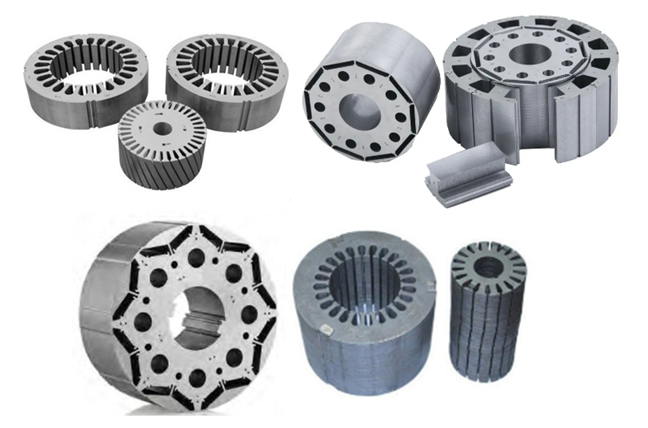
Ask anybody what makes a drone fly and they will say "the propellers" or "the battery". Ask a motor engineer and the answer is different. A drone stays in the air only as long as its motors can turn battery power into thrust without wasting it as heat. Inside every one of those motors is a small stack of very thin silicon steel sheets. The quality of that stack quietly decides how long the drone flies, how hot the motor runs, and how many years it lasts.
This guide is written for everybody who works around drones: farmers' cooperatives buying an agri drone, start-up founders designing a delivery drone, defence engineers, students, and PhD scholars who want one place to understand the full picture. We start with why drones suddenly became so easy to build, explain every drone design and every motor type, go deep into laminations and sizing, look at where India stands, and then break down the real problems drone makers face using the Toyota Way of thinking (TBP and PDCA): problem, root cause, countermeasure.
- Why drones became so important
- Why drones became so easy to build: electronics and manufacturing
- Drone designs, and which ones make logistics easy
- Every drone application, sector by sector
- How a drone motor works
- Types of drone motors: outrunner, inrunner, frameless and more
- Why laminations matter, and how the lamination industry helped drones
- How drone motor size and lamination thickness are decided
- How to make a better motor choice, step by step
- How India is moving in this direction
- Pain points drone makers face today
- Root causes
- Solutions for each root cause (PDCA)
- Why machine efficiency matters for drone laminations
- How SNV is moving in this direction
- Frequently asked questions
Deep-dive guides in this series:
→ Agriculture drone motors: choosing motors that survive Indian fields
→ Drone motor size chart: what 2207, 4114 and KV really mean
→ Outrunner vs inrunner vs frameless motors
→ Drone motor lamination thickness: 0.35 vs 0.20 vs 0.10 mm
→ Made-in-India drone motors for defence: the localisation gap
1. Why drones became so important
Ten years ago, most people saw a drone as a camera toy for weddings. Today drones spray crops, carry blood samples between hospitals, map land records, inspect power lines, deliver groceries and fight wars. Three simple facts explain this change:
- A drone does the work of a helicopter at the cost of a motorcycle. An aerial survey that needed a manned aircraft can now be flown by one trained pilot with a bag-sized machine.
- It removes people from danger and drudgery. No farmer standing in pesticide mist, no lineman climbing a live tower, no soldier walking into an ambush to look over the next hill.
- It reaches places roads do not reach, faster. In Indian cities a delivery drone can cover 7.5 km in 3 to 4 minutes, where the same trip takes about 15 minutes by road.
Market studies do not agree on one number, because some count only civil drones and others include defence. One forecast puts the global drone market at about US$ 100.7 billion in 2026, rising to US$ 210 billion by 2034. A civil-only study puts the civil market at US$ 44.4 billion in 2026, growing to US$ 83 billion by 2035 at 7.2% a year. Either way, the direction is clear. And every one of those drones needs four, six, eight or more motors.
2. Why drones became so easy to build: electronics and manufacturing
Pilotless aircraft have existed for about a hundred years, but for most of that time they were costly military machines built by a few governments. In just the last fifteen years the drone became something a start-up in Bengaluru, a college lab in Chennai or a farmer cooperative in Punjab can build, buy and repair. Nothing magical happened. Two families of technology matured at the same time and became cheap because other big industries paid for their development:
- Electronics, paid for by the smartphone and computer industry.
- Manufacturing of motors, magnets, steel and batteries, paid for by the appliance, computer-fan and electric-vehicle industries.
A simple way to remember it: a modern drone is a flying smartphone sitting on top of a small EV powertrain.
2.1 The electronics advances
| Advance | What changed | What it did for drones |
|---|---|---|
| MEMS sensors | Gyroscopes, accelerometers, magnetometers and barometers shrank onto chips a few millimetres wide. Smartphones bought them in billions, so the price fell to a few rupees each. | A multirotor is unstable by nature — it would flip over in a second on its own. Cheap sensors let the flight computer measure its tilt and correct it hundreds of times every second. |
| Fast, low-power processors | 32-bit microcontrollers and small application processors became powerful enough to run navigation, control and even AI on a few watts. | One small board now does the job of a full avionics rack: stabilisation, GPS navigation, mission planning, obstacle avoidance. |
| Power electronics (MOSFETs and ESCs) | Switching transistors with very low resistance, and electronic speed controllers (ESCs) with field-oriented control (FOC), switching tens of thousands of times a second. | Brushless motors can be driven smoothly and efficiently, and their speed changed in milliseconds — this is how a drone holds steady in wind. |
| Lithium batteries | Lithium-polymer and lithium-ion cells hold roughly double the energy per kg of older nickel cells and can deliver very high current. Pack prices fell by around 90% between 2010 and the mid-2020s, driven by phones, laptops and EVs. | Electric flight of 20–60 minutes became practical and affordable. |
| Satellite navigation | Small GNSS modules (GPS, NavIC, Galileo) with RTK correction now give centimetre-level position. | Autonomous waypoint missions, accurate crop spraying lines, return-to-home, precise land survey. |
| Cameras and AI | Phone camera sensors and on-board AI chips. | Mapping, crop health imaging, target tracking, obstacle avoidance — without a human looking at the screen. |
| Radio links and software | Digital video links, 4G/5G modems, satellite links, and open-source autopilot software built by thousands of engineers worldwide. | A new drone company does not need to write flight software from zero. It can focus on its airframe, payload and service. |
2.2 The manufacturing advances
| Advance | What changed | What it did for drones |
|---|---|---|
| Mass production of BLDC motors | Computer fans, hard disks, appliances and later EVs made brushless motor production a mature, high-volume industry. | Reliable, efficient drone motors became available in hundreds of sizes at low cost. |
| Rare-earth magnets at scale | Neodymium-iron-boron (NdFeB) magnets, invented in the early 1980s, are now produced in large volumes in many grades and shapes. | Very high torque from a small, light motor — the outrunner drone motor depends on these magnets. |
| Thin, low-loss electrical steel | Steel mills learned to roll non-oriented silicon steel (CRNO) down to 0.10–0.27 mm with good coatings and low loss at 400–1,000 Hz, largely for EV and compressor motors. | Drone motors can run at very high magnetic frequency without overheating. This is the hidden enabler of long flight time. |
| High-speed precision stamping | Rigid high-speed presses, servo feeders and progressive dies with in-die stacking and skewing now punch stator and rotor laminations by the million with burr in the range of a few hundredths of a millimetre. | Accurate, repeatable stator stacks at a price drone makers can afford. |
| Automatic winding | Needle and flyer winding machines wind small multi-pole stators quickly with consistent turns. | Motor-to-motor consistency, so all four or eight motors on a drone behave the same. |
| CNC machining and die casting | Aluminium motor bells, shafts and housings turned and milled in large volumes with micron-level accuracy. | Balanced rotors, true air gaps, low vibration at 10,000–40,000 rpm. |
| Composites, moulding and 3D printing | Carbon-fibre sheet and tube, glass-filled nylon mouldings, and 3D printing for prototypes. | Light, stiff frames; a new airframe can go from idea to test flight in weeks. |
| Electronics assembly (SMT) | Automatic pick-and-place lines build flight controllers and ESCs by the thousand. | Cheap, reliable electronics even for small Indian drone makers. |
The key lesson for India: drones became easy because the supply chain became mature — not because one company invented something. Whichever country owns the supply chain of motors, magnets, laminations, batteries and chips will own the drone industry. That is why India is now pushing hard to localise drone components, not just assemble drones (see Section 10).
3. Drone designs, and which ones make logistics easy
Different jobs need different airframes. The airframe decides how many motors the drone needs, what type, and how hard those motors must work.
| Design | How it flies | Strengths | Limits | Motor needs |
|---|---|---|---|---|
| Multirotor (quad, hexa, octo, coaxial X8) | 4 to 16 fixed-pitch propellers. The computer changes each motor's speed to steer. | Hovers, takes off anywhere, simple mechanics, easy to fly. | Uses a lot of energy just to stay up. Usually 20–45 minutes flight. | Outrunner BLDC, direct drive. Motors work hard all the time. Efficiency is everything. |
| Fixed-wing | Wings make lift; one or two motors only push forward. | 2 to 5 times longer range than a multirotor for the same battery. | Needs a runway, catapult or parachute. Cannot hover. | One pusher or tractor motor, cruise efficiency matters. |
| Hybrid VTOL (quadplane, tilt-rotor, tail-sitter) | Takes off like a multirotor, then flies on wings. | Hover plus long range. Best of both. | More complex, extra weight of lift motors in cruise. | Lift motors (high thrust for short time) plus cruise motor (high efficiency for long time). |
| Single-rotor helicopter | One main rotor plus tail rotor. | Efficient hover with heavy payload, long endurance if fuel-powered. | Mechanically complex, more maintenance. | Large motor or engine with gearbox; inrunner often used. |
| Tethered drone | Power comes up a cable from the ground. | Can stay up for days. Used for surveillance masts and telecom. | Fixed location. | Continuous duty motors — heat is the main enemy. |
| Nano / micro drones | Palm-sized, sometimes under 50 g. | Indoor use, soldier-carried reconnaissance. | Very short range, weather-sensitive. | Tiny brushed coreless or micro BLDC motors. |
| Ducted fan / EDF | Propeller inside a duct. | Safer near people, compact, high speed. | Lower hover efficiency. | High-speed inrunner motors. |
What makes drone logistics easy
For delivery, the best design is the one that gives range without a runway. That is why most serious delivery drones today are either multirotors for short city hops (up to about 10 km) or hybrid VTOL aircraft for longer routes. Six things have made drone logistics practical:
- VTOL hybrid airframes — they take off from a rooftop hub and cruise on wings, so range rises without a runway.
- Winch and tether delivery — the drone hovers high and lowers the package on a line, so it never lands in a crowded lane, and propeller noise and dust stay away from people.
- Docking stations and battery swap — the drone lands, a fresh battery goes in, and it leaves again, so one aircraft does many flights a day.
- BVLOS rules and air traffic software — drones flying beyond the pilot's sight with digital flight permission. India's Digital Sky platform and green zones made this easier.
- Efficient motors — every 1% of motor efficiency saved becomes extra range or extra payload. For a logistics company running thousands of flights a day, this is direct profit.
- Reliability — a delivery drone flies over homes. One motor failure can end a business. Hexacopters and octocopters can survive one motor failure; but the real answer is motors that do not fail.
In India, delivery drones from one Gurugram-based operator now carry payloads of up to 10 kg for retail goods and medical supplies. The same operator says it completed 3.6 million deliveries in two and a half years.
4. Every drone application, sector by sector
Here is a full list of where drones work today. For each, we note what the job demands from the motor, because that is what a motor maker must design for.
| Sector | Uses | What it demands from the motor |
|---|---|---|
| Agriculture | Pesticide and fertiliser spraying, nano-urea spraying, seed broadcasting, crop health mapping (NDVI), locust control, orchard pollination support, irrigation mapping, crop insurance surveys. | Heavy lift (10–40 kg tanks), large propellers, low KV high-torque outrunners. Must resist chemical spray, dust and moisture (IP-rated, sealed bearings). Hot Indian summers make heat a constant problem. |
| Medical and healthcare | Blood, vaccines, medicines, lab samples, organs and corneas, anti-venom to remote villages, AED delivery for heart attacks, TB sample transport. | Highest reliability, quiet running, temperature-controlled boxes (extra weight), long range VTOL. |
| Logistics and e-commerce | Quick-commerce, food, parcels, spare parts to factories and ships, island and hill deliveries, mail. | Efficiency (cost per km), many cycles per day, long life, low noise. |
| Defence | Surveillance (ISR), loitering munitions, FPV strike drones, swarms, decoys, artillery spotting, cargo to high-altitude posts, electronic warfare, target drones, naval drones. | Power density, burst power, no foreign-hostile components, wide temperature range (−20 °C in Ladakh to +50 °C in Rajasthan), volume production at low cost for FPV. |
| Homeland security and police | Border patrol, crowd monitoring, traffic management, anti-smuggling, prison monitoring, counter-drone interceptors. | Endurance, quick launch, interceptor drones need very high-speed motors. |
| Disaster management | Flood and cyclone survey, search and rescue with thermal cameras, dropping life jackets and food, earthquake damage mapping, landslide watch. | Must fly in rain and wind. Waterproof motors and high thrust margin. |
| Firefighting | Forest fire spotting, high-rise fire extinguishing drones, tethered hose drones. | Heat-resistant magnets and insulation, very high thrust. |
| Survey and mapping | Land records (SVAMITVA property cards), town planning, road and railway alignment, mining volume, coastal mapping. | Long endurance fixed-wing or VTOL, stable smooth motor for sharp images. |
| Infrastructure inspection | Power transmission lines, wind turbines, solar farms, bridges, dams, telecom towers, pipelines, boilers and chimneys, ship hulls. | Precise control near structures, low vibration, magnetic interference control near power lines. |
| Construction | Progress monitoring (highway projects), site surveys, stockpile measurement, safety checks, real-estate marketing. | Mid-size mapping quadcopters, reliability. |
| Mining, oil and gas | Open-pit surveys, blast monitoring, gas leak detection, flare stack inspection, offshore platform deliveries. | Dusty, hot and sometimes hazardous areas — sealed motors. |
| Environment and forestry | Seed-ball plantation, tree counting, wildlife census, anti-poaching, air-quality sensing, glacier and river studies. | Long endurance, low noise near animals. |
| Fisheries and marine | Fish shoal spotting, coastal watch, oil spill tracking, ship-to-shore delivery. | Salt-water corrosion resistance. |
| Media, sports and events | Filmmaking, live sports broadcasting, drone light shows with hundreds of drones, journalism. | Very smooth low-vibration motors (gimbals use frameless motors), silent running. |
| Telecom | Tethered drones as temporary mobile towers during disasters and big events, tower audits. | Continuous duty for days. |
| Industry and warehouses | Indoor inventory counting with barcode scanning, plant inspection, confined-space checks. | Small, safe, quiet motors. |
| Insurance and finance | Crop loss assessment, roof and property claims. | Mapping drones. |
| Education, research, hobby | Drone training schools, university research, FPV racing, STEM kits. | Cheap, rugged, high-power FPV motors (very high KV). |
| Advanced air mobility | Cargo drones of 100–500 kg, and passenger eVTOL air taxis — the "big brother" of the drone. | Large high-torque motors, often axial flux or large outrunners, aerospace quality systems. |
One more application deserves a special mention for India: Namo Drone Didi. This central scheme, with an outlay of ₹1,261 crore, aims to give 15,000 drones to women's self-help groups for farm spraying. By January 2026, 1,094 drones had been handed over to women's SHGs, 500 of them under this scheme. An agri hexacopter or octocopter carries six to eight heavy-duty motors, so even this one programme is a demand of about one lakh motors.
5. How a drone motor works
A drone motor is a permanent magnet brushless DC motor, more correctly a permanent magnet synchronous motor driven by an ESC. It has two main parts:
- Stator — a stack of thin silicon steel laminations with teeth (slots), with copper coils wound on the teeth. It does not move.
- Rotor — a ring of permanent magnets fixed to a steel back-iron. It rotates.
The ESC sends current through the coils in a fixed sequence. This creates a rotating magnetic field in the stator teeth. The magnets on the rotor keep chasing this field, and the rotor turns. The faster the ESC switches, the faster the motor turns.
The language of drone motors
| Term | Meaning | Example |
|---|---|---|
| Size code (e.g. 2207) | Stator diameter (mm) + stator height (mm) | 2207 = 22 mm stator OD, 7 mm stack. 4114 = 41 mm, 14 mm stack. |
| KV | No-load rpm per volt | 1750 KV × 22.2 V (6S) ≈ 38,850 rpm no-load |
| N/P (e.g. 12N14P) | Number of stator slots (N) and rotor magnet poles (P) | 12 slots, 14 magnets — the most common drone combination |
| Thrust and g/W | Push produced, and grams of thrust per watt | Higher g/W at hover = longer flight |
| Kt | Torque per amp; roughly 9.55 ÷ KV (in N·m/A) | Low KV = more torque per amp |
The most important formula in this whole guide
The magnetic field in the stator changes direction every time a magnet pole passes a tooth. How many times per second? That is the electrical frequency:
f (Hz) = rpm × (number of magnet poles ÷ 2) ÷ 60
Now see what this means in practice:
| Motor | Poles | Typical loaded speed | Electrical frequency |
|---|---|---|---|
| Ordinary 4-pole industrial induction motor | 4 | 1,440 rpm | 50 Hz |
| Ceiling fan BLDC motor (outer rotor) | 16–20 | ~350 rpm | ~50–60 Hz |
| Mapping quadcopter, 35-class motor | 14 | ~5,000 rpm | ~580 Hz |
| Agri drone heavy-lift motor (36N42P class) | 42 | ~2,800 rpm | ~980 Hz |
| 5-inch FPV racing motor, 2207 | 14 | ~30,000 rpm | ~3,500 Hz |
(Speeds are typical illustrative values; real values depend on propeller, battery and throttle.)
A drone motor's steel is magnetised and demagnetised 10 to 70 times faster than the steel in a normal factory motor. This one fact changes everything about how its laminations must be made. Keep it in mind for Section 7.
6. Types of drone motors
6.1 Outrunner BLDC — the workhorse of multirotor drones
The stator is fixed in the centre and the magnet bell rotates around it. The propeller bolts directly on the bell.
- Why drones love it: torque grows with the square of the air-gap radius. Because the magnets are on the outside, an outrunner gives much more torque per kg at moderate speed. It can turn a large propeller directly, with no gearbox — fewer parts, less weight, less failure.
- Typical sizes: 1103–1408 (micro drones), 2204–2810 (FPV and small quads), 3508–5010 (mapping), 6215–12020 and above (agri and heavy-lift; 80–120 mm class stators).
- Limits: the rotating bell is harder to cool and to seal against dust and spray; magnets on the outside face high centrifugal force at high speed.
6.2 Inrunner BLDC — speed specialist
The rotor with magnets spins inside the stator, like a normal industrial motor.
- Strengths: very high rpm (40,000 to 100,000+), low rotor inertia, the stator is outside so heat escapes easily through the housing; easy to fully seal.
- Uses: electric ducted fans (EDF), high-speed fixed-wing and target drones, geared helicopter drones, interceptor drones, some loitering munitions.
- Lamination challenge: very high speed plus many poles gives very high frequency — thin steel is a must.
6.3 Frameless motors — built into the machine
A frameless motor is supplied as just a stator and a rotor — no housing, no shaft, no bearings. The drone or gimbal maker builds them straight into their own structure.
- Uses: camera gimbals (smooth, slow, precise motion, often with a hollow centre for cables), actuators for control surfaces, payload release mechanisms, custom defence drones where every gram and every millimetre is designed.
- Why it matters for India: a frameless kit is mostly laminations, magnets and copper. A country that can make precise stator and rotor stacks can supply frameless motors to its own defence and aerospace makers without importing complete motors.
See the full side-by-side comparison in outrunner vs inrunner vs frameless motors.
6.4 Other types you will meet
| Type | Where used | Notes |
|---|---|---|
| Brushed coreless DC | Toy and nano drones under ~100 g | Cheap and light, but short life. Being replaced by micro BLDC. |
| Axial flux (pancake) | Heavy-lift cargo drones, eVTOL | Flat disc shape, very high torque density. Uses soft magnetic composite, tape-wound or segmented laminated cores. |
| Slotless / coreless BLDC | Ultra-smooth gimbals, high-speed micro motors | No cogging, lower torque density. |
| Halbach-array motors | High-end aerospace | Special magnet arrangement concentrates flux; costly. |
| Hybrid (engine + generator) | Long-endurance cargo and agri drones | A small engine drives a generator; electric motors still drive the propellers. |
7. Why laminations matter, and how the lamination industry helped drones
If you cut open a drone motor stator, it looks like solid metal. It is not. It is a stack of dozens of very thin silicon steel sheets, each one coated with a thin insulation layer, pressed together. A 7 mm tall FPV stator made from 0.2 mm sheet has about 35 sheets. Why go to this trouble?
7.1 Core loss: where flight time is lost
Every time the magnetic field changes direction, the steel loses some energy as heat. This "iron loss" or "core loss" has two main parts:
- Hysteresis loss — energy lost in flipping the magnetic domains in the steel. It rises roughly in step with frequency. It is reduced by better steel (higher silicon, cleaner grain, stress-free edges).
- Eddy current loss — small circulating electric currents induced inside the steel itself. These rise with the square of frequency and the square of sheet thickness.
Eddy loss per kg  ∝  (t × f × B)² ÷ ρ
t = sheet thickness, f = frequency, B = flux density, ρ = electrical resistivity of the steel
At 50 Hz, eddy loss is small and a 0.5 mm sheet is fine. A drone motor running at 1,000–3,500 Hz is a different world. Eddy loss that was a small part of total loss at 50 Hz becomes the biggest part. The only practical ways to control it are: thinner sheet, higher resistivity steel (more silicon), and perfect insulation between sheets.
| Sheet thickness | Relative eddy loss (0.35 mm = 1.00) | Typical use |
|---|---|---|
| 0.50 mm | 2.04 | Fans, pumps, appliances, 50 Hz industrial motors |
| 0.35 mm | 1.00 | EV traction, compressors, mid-frequency BLDC |
| 0.27 mm | 0.60 | High-speed EV motors, budget drone motors |
| 0.20 mm | 0.33 | Quality drone motors, high-speed spindles |
| 0.15 mm | 0.18 | Premium drone, aerospace, very high-speed motors |
| 0.10 mm | 0.08 | Aerospace, military, kHz-range motors |
(Calculated from the thickness-squared rule at the same frequency, flux density and resistivity. Real steel data also changes with grade, coating and processing.)
Going from 0.35 mm to 0.20 mm cuts eddy loss to one-third. That saved energy is either extra flight minutes, extra payload, or a cooler motor that lives longer. This is exactly why higher-end FPV motors moved to 0.2 mm stator laminations while budget motors stayed with 0.3 mm. Hobby pilots who strip motors apart notice the same split.
7.2 What the lamination industry did for drones
Drones could not have become efficient without three advances in electrical steel and stamping:
- Thin-gauge, high-frequency silicon steel. Steel mills developed non-oriented (CRNO) grades in 0.10–0.27 mm with higher silicon (about 3% and above) and better coatings, specified for loss at 400 Hz and 1 kHz, not only 50 Hz. Some mills even produce 6.5% silicon steel for kHz motors.
- Better insulation coatings. Thin inorganic and organic coatings keep each sheet electrically separate even after punching and stacking. Self-bonding ("backlack") coatings let a stack be glued in an oven instead of welded or interlocked — very useful for thin sheet.
- High-speed precision stamping. Punching 0.2 mm steel is much harder than punching 0.5 mm. The punch-to-die gap must stay around 5–10% of sheet thickness — that is only 10 to 20 microns for 0.2 mm sheet. This needs rigid presses, accurate servo feeding, well-maintained progressive tooling and in-die stacking. The lamination industry built this capability for EVs and compressors, and drones are now using it.
For a full comparison of sheet thicknesses, grades and stack-joining methods, read our drone motor lamination thickness guide.
7.3 The hidden enemies inside a lamination stack
| Defect | What happens | Why it hurts drones more |
|---|---|---|
| Burr | A tiny sharp edge left by punching. Burr can cut through the insulation of the next sheet and short them together. | On thin sheet, burr is a bigger share of the thickness, so it must be kept low and checked every lot. Shorted sheets behave like one thick sheet — and eddy loss shoots up. |
| Cut-edge stress | Punching damages the magnetic property of the steel near every cut edge. | Drone stator teeth are often only 1.5–3 mm wide. A large share of each tooth sits inside the damaged zone. |
| Low stacking factor | Gaps, coating and burr mean less steel in the same stack height. | Less steel means higher flux density, more saturation, less torque. |
| Stack height variation | Stacks of the same part come out at different heights. | Different motors on the same drone give different thrust; the flight controller must work harder; coil resistance varies. |
| Joining method damage | Welding, riveting or interlocking creates short-circuit paths and local stress. | At kHz frequency, each weld line behaves like a loop for eddy currents. |
| Out-of-round or eccentric stack | Uneven air gap between stator and magnets. | Vibration, noise and torque ripple — bad for camera quality and bearing life at high rpm. |
8. How drone motor size and lamination thickness are decided
Motor sizing is not guesswork. It follows a chain: mission → weight → thrust → propeller → speed → torque → stator size → poles → frequency → lamination.
8.1 Start from the thrust you need
The rule of thumb is that the motors together must give at least twice the all-up weight (AUW) of the drone at full throttle, so it hovers at about half throttle and still has power to climb and fight wind.
| Drone type | Thrust-to-weight target | Why |
|---|---|---|
| Agriculture / heavy-lift | 1.8 : 1 to 2.2 : 1 | Payload is large; efficiency at hover matters most. |
| Mapping / delivery | 2 : 1 to 2.5 : 1 | Safety margin for wind and gusts. |
| Defence ISR | 2.5 : 1 to 3 : 1 | Agility, high altitude (thin air reduces thrust). |
| FPV racing / strike | 5 : 1 to 10 : 1 | Extreme acceleration; short flights. |
8.2 Worked example: a 10-litre agri hexacopter
- All-up weight with full tank ≈ 25 kg.
- Target thrust 2 : 1 → 50 kg total → about 8.3 kg per motor at full throttle, about 4.2 kg each at hover.
- Large propellers (about 30–36 inch) give the best hover efficiency, so the motor must turn slowly with high torque → low KV (roughly 80–130 KV on a 12–14S battery).
- High torque at low speed → large diameter stator, typically in the 80–100 mm class, with many poles (for example 36 slots and 42 poles) to give torque without a gearbox.
- Check frequency: about 2,800 rpm × 21 pole pairs ÷ 60 ≈ 980 Hz.
- At ~1 kHz, a 0.35 mm sheet makes the motor run hot in an Indian summer. 0.20–0.27 mm high-frequency CRNO is the sensible choice; 0.35 mm only if cost forces it and the hover duty is short.
More worked examples for every drone class are in our drone motor size chart, and agri-specific advice is in agriculture drone motors.
8.3 Diameter versus height
Torque is roughly proportional to rotor diameter² × stack length. So doubling stack height doubles torque, but doubling diameter gives about four times.
- Wide and short (e.g. 2306, 6010): more torque, faster response, more surface for cooling, more poles possible. Favoured for agility and large propellers.
- Narrow and tall (e.g. 2210, 4120): more copper and steel for continuous power in a small diameter. Favoured where frame space is tight.
Every 1 mm of stack height is a design decision: it adds steel weight, copper length and cost. This is why stack height accuracy from the lamination supplier is so important.
8.4 How lamination thickness is chosen
| Electrical frequency at working point | Suggested CRNO thickness | Notes |
|---|---|---|
| Up to ~200 Hz | 0.35–0.50 mm | Slow, low-pole motors; rare in drones. |
| 200–600 Hz | 0.27–0.35 mm | Some mapping and delivery motors. |
| 600–1,500 Hz | 0.20–0.27 mm | Agri and heavy-lift motors, mid-size quads. |
| 1,500–3,000 Hz | 0.15–0.20 mm | FPV, high-KV motors, inrunners. |
| Above 3,000 Hz | 0.10–0.15 mm, or special high-silicon steel | Aerospace, defence, very high-speed motors. |
(A practical guide only. The final choice comes from the loss budget, duty cycle, cooling and cost. Always check the steel mill's loss data at your actual frequency — for example W10/400 or W10/1000.)
Thinner is not always better. Thinner sheet costs more per kg, gives a slightly lower stacking factor, is harder to punch and stack, and takes more strokes per stator. The right answer is the thinnest sheet whose extra cost is paid back in flight time or reliability.
9. How to make a better motor choice, step by step
Here is a checklist we suggest to drone makers, in the order the Toyota Way teaches: first understand the job (genchi genbutsu — go and see), then decide.
- Define the mission. Payload, flight time, range, altitude, temperature, rain and dust exposure, noise limits, expected life in hours.
- Estimate all-up weight and fix the thrust-to-weight target from the table above.
- Choose the propeller first. Bigger and slower propellers are more efficient for hover. The motor is chosen to suit the propeller, not the other way around.
- Fix battery voltage and KV so the motor reaches the needed rpm at about 50–60% throttle in hover.
- Size the stator for the torque needed, with a temperature margin. Check continuous current, not only peak.
- Pick the slot-pole combination (12N14P, 24N28P, 36N42P etc.) balancing torque, smoothness and frequency.
- Calculate the electrical frequency and choose lamination grade and thickness from Section 8.4.
- Choose magnet grade by temperature — a magnet that is fine at 60 °C can lose strength permanently at 120 °C. Grades marked H, SH or UH are made for higher temperatures.
- Specify the stack properly on the drawing: burr limit, stacking factor, stack height tolerance, joining method (interlock, bonding, welding), concentricity, and coating class.
- Test on a thrust stand: thrust, current, g/W at hover throttle, temperature after 10 minutes of hover, and vibration. Compare at least two lamination options if you can.
- Check supply chain: where do the magnets, steel and stacks come from? Is the source allowed for defence use? What is the lead time if demand doubles?
10. How India is moving in this direction
India has gone from importing drones to banning their import and building its own industry in about five years.
10.1 Policy steps
- Drone Rules 2021 simplified permissions and opened civil drone operations, later allowing civilian drones up to 500 kg. Fees were cut and delinked from drone size.
- PLI scheme for drones and components with ₹120 crore, giving a 20% incentive on value addition. The Drone Federation says the industry's turnover grew from about ₹60 crore to about ₹4,000 crore, crediting the PLI scheme, the drone rules and the ban on foreign drones.
- Import ban (Feb 2022) on fully built and kit drones, with components still allowed — which pushed assembly to India but left the parts gap open.
- Defence ban on Chinese parts in military drones, applied through military tenders, over the risk of compromised intelligence. The Defence Ministry also published a draft security framework in March 2026 with strict testing and a 20-point check before clearance.
- A new ₹2,000 crore incentive programme after Operation Sindoor, covering drones, components, software and counter-drone systems, with a goal to make at least 40% of key drone parts in India by FY 2027–28.
- Agriculture schemes: Kisan Drones under the farm mechanisation mission and Namo Drone Didi. Between 2023–24 and 2025–26, 2,122 drones were approved for distribution, and more than 40,000 Kisan Drone demonstrations covered about 41,000 hectares.
10.2 Market size
One industry report put India's commercial drone market at US$ 1.88 billion (₹17,000 crore) in FY26, growing at about 18% a year to FY29. Another projection, quoted at a recent defence conference, expects the Indian drone industry to grow from ₹5,720 crore in 2025–26 to about ₹97,300 crore by 2030–31. By February 2026 India had over 38,500 registered drones, about 40,000 certified remote pilots and 244 approved training organisations.
10.3 Defence demand after Operation Sindoor
The Army Chief has said Army units themselves produced about 40,000 drones in FY 2025. The Army has also announced plans to buy 1,000 surveillance drones and 1,000 kamikaze (loitering) drones, and an Indian maker recently signed a ₹137 crore emergency contract to supply hybrid mini UAVs that were used during the operation. Another Indian pair of companies won a ₹1,577 crore order for 840 long-range attack drones in August 2026.
10.4 The motor gap — the honest picture
Here is the uncomfortable part. India assembles drones, but much of the propulsion still comes from outside:
- From March 2022 to February 2023, India imported drone motors, sensors, batteries and cameras worth US$ 50–70 million, 53% more than the year before. Industry people estimate propulsion (motors, ESCs, power electronics) at nearly 40% of the imported component value.
- One Indian defence company says that as much as 80% of the motors and controllers inside Indian military drones traced back to Chinese-origin channels, and that most domestic makers still assemble imported parts.
- Rare-earth magnets are the second chokepoint. China controls about 94% of permanent magnet production, according to the IEA. The drone sector alone used 3,000–8,000 tonnes of rare-earth magnets in 2025, about 3% of total demand. China's export curbs since April 2025 hit motor makers across the world.
- The steel side is improving. India's largest steel maker is building a CRNO electrical steel line of about 6 lakh tonnes a year at Vijayanagar, Karnataka. Thin-gauge high-frequency grades (0.20 mm and below) are still mostly imported, and Indian buyers should plan for that.
So the opportunity is clear. A drone is "Made in India" only when its motor is made in India, and the motor is made in India only when its stator and rotor stacks, magnets and windings are made here. Laminations are the part India can localise fastest, because the press shop skill already exists in our automotive and appliance industry.
We cover the defence localisation story in detail in Made-in-India drone motors for defence.
11. Pain points drone makers face today
Following the TBP method, we first clarify the problem and break it into small parts. These are the problems we hear most from drone and motor makers:
| # | Pain point | How it shows up |
|---|---|---|
| P1 | Motors run hot, flight time lower than design | Agri drone gives 2–3 fewer spray minutes in May than in January; thrust drops as the motor heats. |
| P2 | Batch-to-batch inconsistency | Two motors of the same model on one drone draw different current; the flight controller compensates; one motor always runs hotter. |
| P3 | Early motor failures in the field | Burnt windings, weak magnets, bearing failure, corrosion after chemical spraying. |
| P4 | Vibration and noise | Blurred camera images, gimbal jitter, complaints in residential delivery zones. |
| P5 | Import dependence and long lead times | 8–12 week waits, sudden price jumps, export controls, defence projects rejected for foreign parts. |
| P6 | Prototype-to-production gap | Laser-cut prototype stacks work well; first production stacks from a die perform worse, or the die is too costly for the volume. |
| P7 | Cost pressure | Indian drone prices must compete with imported equivalents; the motor is one of the biggest cost items. |
12. Root causes
Now we ask "why" until we reach causes we can act on. Many problems trace back to the stator and rotor stack, not only to the motor design.
| Pain | Root causes (break-down) |
|---|---|
| P1 Heat, low flight time | (a) Lamination too thick or wrong grade for the actual frequency. (b) Burr shorting sheets together. (c) Cut-edge stress in narrow teeth. (d) Welding or interlocks placed in the main flux path. (e) Low stacking factor raising flux density. |
| P2 Inconsistency | (a) Stack height variation from sheet thickness variation and loose counting. (b) Burr growing as the tool wears, with no regrind plan. (c) Different coils / different steel lots mixed. |
| P3 Early failure | (a) Heat from P1 cooks insulation and weakens magnets. (b) Sharp burr on slot edges damages winding insulation. (c) Wrong magnet temperature grade. (d) Poor sealing against spray. |
| P4 Vibration, noise | (a) Eccentric or out-of-round stack. (b) Uneven skew. (c) Shaft runout. (d) Magnet placement variation. |
| P5 Import dependence | (a) Few Indian suppliers equipped for thin-gauge, small-diameter, high-precision stacks. (b) Thin steel and magnets imported. (c) Buyers not knowing local options exist. |
| P6 Prototype gap | (a) Laser or wire-cut prototype edges behave differently from punched edges. (b) Different joining method between prototype and production. (c) Tool designed without DFM review. |
| P7 Cost | (a) Poor material yield in strip layout. (b) Low press uptime (OEE). (c) Over-specification — thinnest steel used where it is not needed. |
13. Solutions for each root cause (PDCA)
| Root cause | Countermeasure |
|---|---|
| Wrong thickness / grade | Calculate electrical frequency at the real hover point, not at max rpm. Choose steel by loss at that frequency (W10/400, W10/1000), and compare two options on a thrust stand. Use the thinnest sheet only where the gain pays back. |
| Burr | Correct punch-die clearance for the thickness, the right tool steel for the volume, regrinding by stroke count (not "when burr appears"), a burr limit written on the drawing, and burr measurement every lot. |
| Cut-edge stress | Sharp tools, design teeth slightly wider where possible, and consider stress-relief annealing for critical stacks. |
| Joining in flux path | Place interlocks away from the main flux path; for thin gauge consider self-bonding steel or adhesive bonding instead of welding. |
| Stack height variation | In-die auto stacking with thickness compensation (count by height, not only by number), and 100% height check. |
| Eccentric stack / uneven skew | Rigid press with good parallelism, accurate pilot guidance, in-die auto skewing, concentric shaft turning. |
| Prototype gap | Make prototypes as close to production as possible, discuss DFM before the die is made, and qualify the first production lot against the prototype data. |
| Import dependence | Qualify an Indian lamination source early, dual-source steel, keep safety stock of thin steel, and plan magnet alternatives with the motor designer. |
| Cost | Optimise strip layout (stator and rotor from the same strip), multi-row tools for volume, high OEE, and right-sizing the steel grade. |
14. Why machine efficiency matters for drone laminations
Drone motors are moving from hundreds to millions of pieces. When that happens, the press shop decides two things: quality and cost. Both come from machine efficiency.
14.1 Accuracy: the press decides the burr
For thin sheet, the clearance between punch and die is only a few tens of microns. If the press slide tilts even slightly under load, one side of the punch rubs and the other side gaps open. Burr appears on one side, the tool wears unevenly, and stacking factor drops. That is why a press with a double-plunger design and tight parallelism matters so much more for drone laminations than for thick appliance laminations. The servo feeder must place every pitch accurately on a strip that bends easily, or the sheets will not stack true.
14.2 OEE: the press decides the cost
OEE (Overall Equipment Effectiveness) = Availability × Performance × Quality. A simple illustration for a 22 mm drone stator made from 0.2 mm sheet with a 7 mm stack (about 35 sheets per stator):
| Shop A (OEE 55%) | Shop B (OEE 85%) | |
|---|---|---|
| Theoretical strokes per 8-hour shift at 300 SPM | 1,44,000 | 1,44,000 |
| Good strokes actually made | 79,200 | 1,22,400 |
| Stators per shift (35 sheets each, one per stroke) | ~2,260 | ~3,500 |
| Difference | Shop B makes about 55% more stators from the same machine and the same shift cost | |
(Illustrative numbers only, to show the effect of OEE.)
The same press, same tool, same operators — but the price a customer pays depends heavily on downtime, changeover time and rejection. Quick die change, planned tool maintenance, and tracking of strokes per hour, breakdown hours and rejection PPM are not "factory paperwork". They are what make an Indian lamination competitive with imports.
15. How SNV is moving in this direction
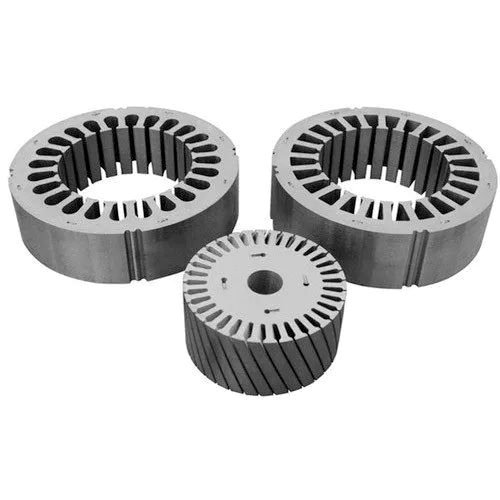
SNV Stamping Solutions Pvt Ltd is an emerging stator and rotor lamination provider in India, based in Bengaluru. Drone and defence motors are one of our main focus areas, along with EV, BLDC, industrial and appliance motors. Our team brings 25+ years of experience from automotive press shops, and we run our plant on lean and PDCA discipline. We believe motor lamination is no longer a commodity. It is engineering.
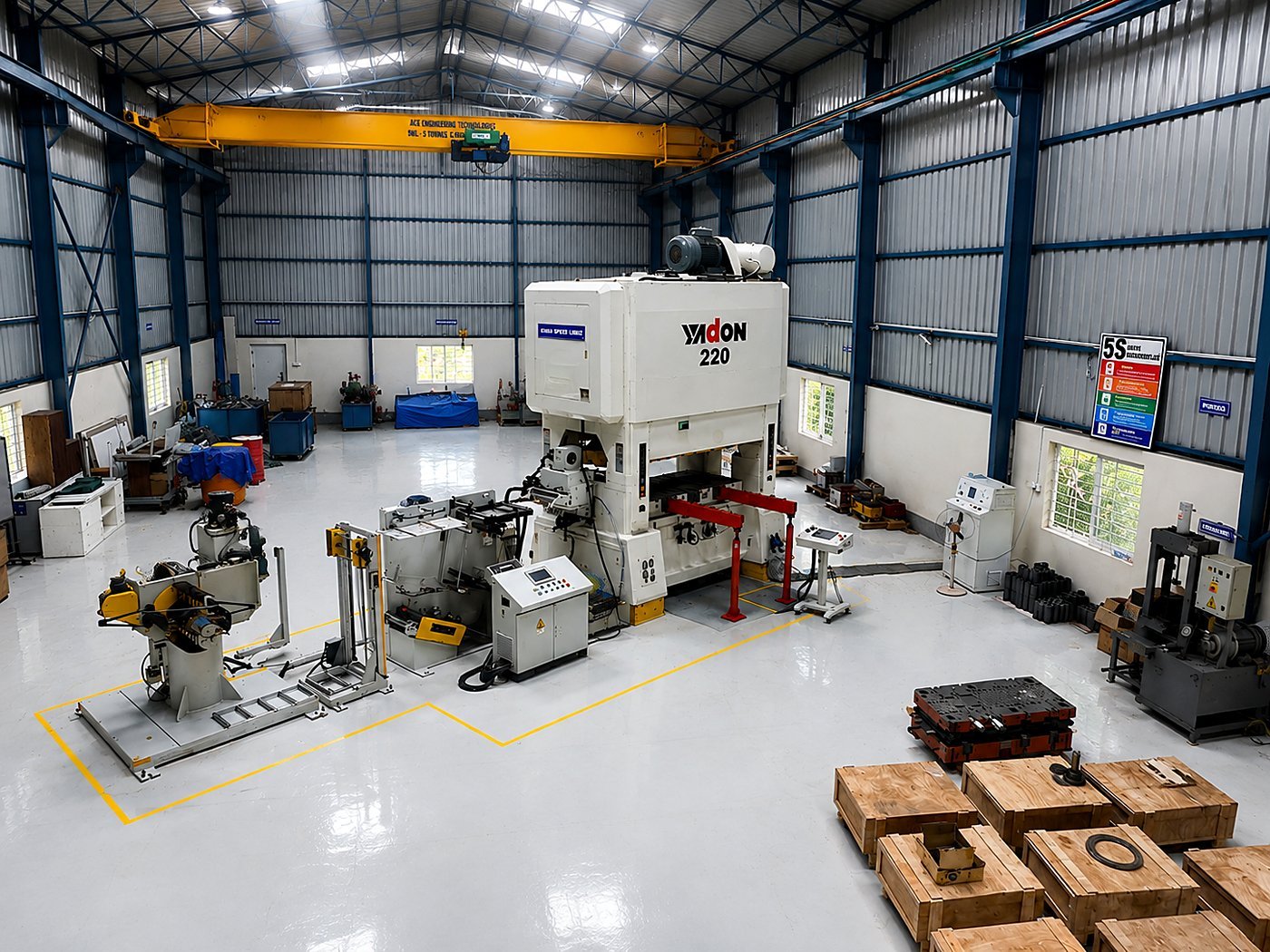
Our competency for drone motor laminations
| What drone motors need | What SNV has |
|---|---|
| Rigid, accurate press for thin-sheet punching | Brand-new 220-ton high-speed press line with a double-plunger design that keeps the tool parallel to the bolster — parallelism within 50 microns. |
| Accurate feeding of thin strip | Servo feeder with decoiler and straightener, handling strip from 0.2 mm to 1.0 mm thick and up to 400 mm wide. |
| Stacks that come out right, every time | In-die auto stacking, auto skewing, and separate cams for rotor and stator so different stack heights are easily achieved. |
| Low burr and good stacking factor | Burr held within 0.02 mm; stacking factor 97–98%; checked on a granite surface plate with stack-height, burr and stacking-factor checks. |
| Right steel | CRNO silicon steel only for BLDC and drone motors — grade and thickness chosen per the motor's frequency and the customer's loss target. |
| True-running rotors | In-house CNC turning for rotor shafts: dimensional accuracy 10–15 microns, concentricity within 30 microns, checked on a bench centre. |
| Fast development | Stator and rotor prototypes, quick die change, and in-house die maintenance with planned regrinding. |
| Quality system | ISO 9001:2015 certified. IATF 16949 implementation started in 2026. We track OEE, strokes per hour, downtime, breakdown hours, rejection PPM and first-pass yield. |
| Beyond laminations | We are moving towards complete motor solutions — turning in-house today, winding in the pipeline. |
For our drone motor lamination service details, see Drone Motor Lamination Manufacturer in India.
What we are working on next
- Thin-gauge drone laminations — our feeder line already handles strip down to 0.2 mm, and we are ready to develop and qualify thin-gauge stacks with drone and motor makers for their designs.
- Bonded stacks — we are exploring self-bonding and adhesive bonding so thin sheets can be joined without welds in the flux path.
- Segmented and large-diameter stators for heavy-lift and cargo drone motors.
- Design-for-manufacturing support — reviewing tooth width, slot shape, interlock position and strip layout with the customer before any die is made.
"We don't just press parts — we are a solution provider for motor laminations of your design."
Building a drone motor in India? Talk to us before you freeze the design.
Send us your stator and rotor DXF or drawing, the motor's speed and pole count, and your target volume. We will suggest the steel grade and thickness for your frequency, review the design for punching, and come back with a prototype plan and quotation.
📧 contact@snvstampings.com | sales@snvstampings.com
📞 9980668620 / 9980717774
🌐 www.snvstampings.com
📍 #42/2, Machohalli, Dasanapura Hobli, Bengaluru North Taluk, Bengaluru – 560091, Karnataka, India
16. Frequently asked questions
Which motor is used in drones?
Almost all modern drones use brushless DC (BLDC) permanent magnet motors. Multirotor drones mostly use outrunner BLDC motors because they give high torque at moderate speed and drive the propeller directly. Very small toy drones still use brushed coreless motors.
What do the numbers on a drone motor like 2207 mean?
The first two digits are the stator diameter in mm and the last two are the stator height in mm. A 2207 motor has a 22 mm diameter stator that is 7 mm tall.
What is KV in a drone motor?
KV is the no-load speed in rpm per volt. A 1750 KV motor on a 22.2 V battery spins at about 38,850 rpm without load. Low KV motors swing big propellers with more torque; high KV motors spin small propellers fast.
Why do drone motors use thin laminations?
Drone motors have many poles and spin fast, so their electrical frequency is often 500–3,500 Hz instead of 50 Hz. Eddy current loss rises with the square of frequency and the square of sheet thickness, so thin silicon steel (0.10–0.27 mm) keeps the motor cool and improves flight time.
Outrunner or inrunner — which is better for my drone?
For multirotors with direct-drive propellers, an outrunner is almost always better. For ducted fans, very high-speed fixed-wing drones and geared drives, an inrunner is usually better.
What is a frameless drone motor?
A frameless motor is supplied only as a stator and a rotor, without housing, shaft or bearings. The maker builds it into their own gimbal, actuator or airframe to save weight and space.
Which steel is used for drone motor laminations?
CRNO (cold-rolled non-oriented) silicon steel, usually in 0.10–0.35 mm thickness, with the grade chosen for low loss at the motor's actual frequency (for example loss at 400 Hz or 1,000 Hz).
Are drone motors made in India?
Yes, a growing number of Indian companies now make drone motors and propulsion systems, but many motors and most rare-earth magnets are still imported. Government schemes target at least 40% local manufacture of critical drone parts by FY 2027–28.
What details should I give a lamination supplier for a drone motor?
DXF or drawing of stator and rotor, sheet thickness and grade (or the frequency and loss target), stack height and tolerance, joining method, burr and stacking factor limits, skew angle if any, and annual volume.
Sources and further reading
- PIB — India's Drone Ecosystem: From Policy to Public Service Transformation (17 Feb 2026)
- Fortune Business Insights — Drone Market Size, 2026–2034
- Drone Industry Insights — Global Drone Market Report 2026–2035
- Drone Federation India president on sector revenue growth (Sep 2026)
- India's commercial drone market to grow at 18% till FY29 (Mar 2026)
- The Pioneer — How drone policy is building an ecosystem
- Namo Drone Didi — scheme outlay and distribution
- The Week — Indian drone component makers aim for the swadeshi switch (Nov 2026)
- The Week — The hidden weakness in India's military drones (Jul 2026)
- Outlook Business — India's drone dream still flies on foreign parts
- Outlook Business — ₹2,000 crore drone incentive and 40% localisation goal
- The Defense Post — India bans Chinese parts in military drones
- RealClearDefense — India's Drone Army (Jul 2026)
- IDRW — Army plans 1,000 surveillance and 1,000 loitering drones
- ThePrint — ₹137 crore emergency contract for mini UAVs
- S&P Global — Drones emerge as the fastest-growing rare-earth demand segment
- CRNO electrical steel project at Vijayanagar, Karnataka (Jun 2026)
- Khaleej Times — India's drone network in cities and villages
- Devdiscourse — Indian drone delivery operator crosses 3.6 million deliveries
- DroneLife — 2 million commercial drone deliveries (Jan 2026)
- DroneXL — Drone delivery in 2026
- United24 — Ukraine produces 10 million drones a year (Jul 2026)
- IntoFPV forum — 0.2 mm vs 0.3 mm stator laminations in FPV motors